It is a turning point for talent acquisition with new specializations popping up each year and an ever-increasing skills gap. Companies can only move forward based on the merits of their tech talent and technical recruiters are the only people who can help find them.
That is why we created the Tech Recruiting Times. We wanted to fill the gap of content for tech recruiters and engineering leaders and help prepare the people on the front lines of these changes.
Every two weeks we will offer advice, opinions, and breaking news through interviews with the industry’s leading professionals.
We hope you enjoy this week’s issue!
This week’s topic
How can recruiters utilize automation rather than be replaced by it? Here are the specific components you need to upskill your sourcing team to the next generation.

This week’s guest: Glenn Gutmacher
%20(2).png?width=240&name=Influencer%20(600%20%C3%97%201000px)%20(2).png)
For our first edition, we sat down with Glenn Gutmacher. Currently the Talent Sourcing Training Mgr. at NVIDIA, Glenn has managed US and offshore diversity sourcing teams at multi-billion-revenue firms like Microsoft and Avanade and trained recruiters from hundreds of companies from the Fortune 500 to small staffing firms. He’s the co-founder of the Boston Area Talent Sourcing Association (BATSA) and DEI Cohort. A Yale University graduate, Glenn has been pioneering recruiting tech since the 1990s.
He joined with New England’s largest newspaper chain to found the award-winning JobSmart website in 1996 (which beat out the Washington Post’s Careers page in 1998 for the industry’s two most prestigious awards (the EpPY and Digital Edge Awards). He also created Recruiting-Online.com, an Internet recruiting seminar that was one of the first self-paced, fully-online talent sourcing courses.
We were excited to hear how Glenn leverages new tech to develop innovative recruiting strategies and tools in scalable, cost-effective ways.
1. What are the critical soft skills of technical sourcers that will make them indispensable (and not AI-replaceable)?
All great technical sourcers have at least four traits: curiosity, diligence, business acumen, and empathy.
Curiosity means they’re not satisfied with what they read in a job description or a resume. They want to learn more and (along with trait #2 diligence) will dig to find out — by asking questions of people (internally and externally) who are familiar with the type of candidate needed, doing research with GlossaryTech, Wikipedia. etc.
Those help them achieve trait #3 (business acumen): Once they understand the context of the role and team beyond the keywords, they can read between the lines when they see a profile or resume and know what areas to probe when speaking to prospects to separate the wheat from the chaff.
Hiring managers appreciate these three traits of technical sourcers, too, because they’re saving them time from not having to speak with marginal candidates who can talk the talk but not walk the walk.

They come to trust their technical sourcer and their recommendations more and the whole candidate journey (and also time-to-qualified slate) moves faster.
Empathy is key because you can appreciate the triggers (for both candidate and the hiring team) and build rapport. You can tailor the discussions to address concerns and smooth the way to advancing to the next stage.
Or, you might mutually determine the current role isn’t the best fit, but learn enough in the process to steer them for a better match.
It’s a bonus if you have a data science/talent intelligence inclination, meaning you like utilizing the stats around the job market.
With these stats, you can act as a talent advisor to hiring managers who insist on a candidate that ticks all the boxes but your research shows there are only 10 of them in the world and being paid FAANG level (or already working for one of them!).
So you’d be smarter to compromise on some must-haves and nice-to-haves that they can learn on the job in a couple of months rather than let the job remain unfilled even longer.
You can explain even if you got lucky hiring someone after that point, you’d be paying them above market rate to poach them AND the retention level will likely be lower because they’d say “been there, done that” for the job duties.
2. Sourcing automation has already revolutionized how sourcers find candidates at scale and also conduct outreach. What are some examples of what you use?
Some things are simple, effective and already widely used because they bear no additional cost, like saving multiple email signatures in Microsoft Outlook with templates covering 90% of the types of communication you have with colleagues and candidates.
That way, only minimal individual customization is necessary for each new or reply message.
Or, save hours per week with a free self-scheduling tool like Calendly or Microsoft Bookings to eliminate back-and-forth time on setting up individual/group interviews and meetings with internal and external invitees.
if you’re on the web, hopefully, you use free Chrome extensions like Magical, which populate common message screens on LinkedIn and other web forms with recipient-customized responses; or OneTab which allow sourcers to consolidate all the inevitably many open browser tabs into one linked page that you can revisit anytime or share with a colleague.
.jpeg?width=600&name=AdobeStock_335969634%20(1).jpeg)
Conversely, you can use something like Link Clump or Open Multiple URLs to quickly open a bunch of links in their own tabs to process the data better for web scraping, etc.
Speaking of web scraping, there are so many options for this, and some of the best ones are free: Instant Data Scraper is the easiest but it doesn’t work on all websites. A more flexible tool is Webscraper.io but it has a higher technical learning curve.
Something in the middle that’s also popular with sourcers like Data Miner might be better, but limits you to 500 pages per month free, then you need to upgrade to a paid license.
3. Why is it so important to have systems/processes for your sourcing strategies? Are there different tiers to the options of tools that you can choose from?
There are many tiers of tool complexity and cost. Unfortunately, some that would add tremendous ROI to every sourcer and recruiter on the team are bypassed by many organizations due to the high barrier to entry (the upfront cost of licenses and/or implementation).
.png?width=600&name=Influencer%20(3).png)
My recommendation is always to focus initially on things that provide fast ROI (particularly if your TA management isn’t experienced in advanced sourcing) because you only get one chance to make a good first impression.
And make sure you measure everything starting at base state so the metrics you can present later for improved quality, time, cost, etc., are clear.
Once they see the value, then you’re in a great position to make the business case to ramp it up further (even if there’s a cost).
But even on the big-ticket items, if you can get your CHRO to see the forest through the trees, they’d realize the time saved once most individual contributors are up to speed matters.
If you take the difference in time to whatever metric — first screen/submit after intake, first offer or hire, or diverse candidate slate on a requisition or pipeline — and multiply it by the number handled per TA staffer, you’ll see the tech more than pays for itself (usually in months, not years, depending on your team size)!
4. What tips or software recommendations could you pass on right now to help address the challenge of diversity in the software industry?
First, avoid language like “diverse software persons” or generalizations for metrics.
As an external TA colleague, Precious Lesley, recently said: “Diversity hiring metrics is an acceptable term: those metrics measure the diversity of the candidates hired by an organization and help identify issues in this area.
But don’t label a human a “diversity hire”.
This is: A) not an accurate use of the term as all humans are part of diversity, but you’d never use the term to describe white, straight, cis-gendered, able-bodied, neurotypical candidates; and B) a form of tokenism that has been proven to not work and goes against the intended goal.
That being said, companies have seen success by such tactics as “blinding” prospects or interviewees.
Many search tools will insert a cat or dog face instead of the person’s name and remove other identifying information automatically, so as not to bias anyone starting from the sourcing stage through the first interview. Otherwise, you can inadvertently filter out promising talent.
Is there really a reason to see someone’s name, location or face at the first evaluation stage? Or is someone who’s disabled really unable to do the job if you put modest accommodations in place (which are probably legally required, anyway)?
I’d much rather allow that visual ID to happen once a decision-maker has made an affirmative call to progress to the next evaluation stage and more eyes are on the process so if that underrepresented talent falls out of the process, managers will notice and ask why.
.png?width=600&name=Influencer%20(7).png)
Conversely, there are many companies where unconscious bias is a less significant problem and they just want help to get more diversity in at the front end of the funnel.
In those situations, I recommend simple techniques like auto-converting your favorite searches by skill sets, job titles, companies, etc., to just face results (e.g., see my bookmarklets page for some free tools).
5. What solutions or strategies do you see key in fostering the transition to more in-depth passive sourcing for tech talent?
As I mentioned before, I think the game-changer technologies tend to be bypassed because of enterprise cost or complexity, but in the end, they should be simple for individual TA end-users to incorporate into their daily work, and thus have high ROI.
Solutions such as a recruiting CRM to house pre-applicant prospects and automatically keep them warm with relevant messaging, or an assessment platform (both for video and virtual reality soft skills as well as hard skills tech testing) can be huge boons for TA organizations — when implemented well.
.png?width=600&name=Influencer%20(5).png)
Unfortunately, in my 25 years of training thousands of sourcers and recruiters, I’ve often seen people latch onto a “bright, shiny object” (as my former Microsoft boss Rob McIntosh explained it in this 2008 recruiting blog post that remains just as true now) but don’t invest in the change management around the revised process that underlies WHY you want the new tool.
In those cases, many organizations launch something due to an enthused internal evangelist, but the rest of the team doesn’t fully appreciate the potential value-add, and soon after they go back to the faulty processes they’re comfortable with but don’t actually advance the TA function.
Now you’ve slapped fancy tech over a faulty process, and that might even cost you more than not adding it at all!
Wrapping Up
For more up-to-date information about the state of tech recruiting, upskilling your sourcing team, and the best recruitment tech to use, check out our blog.
Interested in learning more about how Celential is accelerating the development of AI solutions to recruiting problems?
]]>Deprecated: Creation of dynamic property RankMath\Post::$rank_math_primary_category is deprecated in /www/wwwcelentialai_250/public/wp-content/plugins/seo-by-rank-math/includes/class-metadata.php on line 118
With so many leaders pushing for budget cuts and letting hundreds of employees go, the recruiting process is one the first to be optimized. This is because it has an outsized impact on everything from the quality of the talent you hire to your employer brand to your budget’s bottom line.

However many leaders don’t consider how their candidate sourcing is hurting their overall recruiting process. Many of the traditional ways of finding, hiring, and retaining talent are increasingly outdated and ineffective, burning time and cost without producing results.
Luckily for tech organizations, a digital transformation has washed over the sourcing space, bringing with it all-new and more efficient ways of sourcing hard-to-reach tech talent than before.
According to Mercer’s Global Talent Trends 2022 study, 34% of executives would invest in increased use of AI and automation in the face of an economic downturn, and 38% would look to reduce operational costs — only 23% would slow down their current digital transformation.
In this guide, we’ll look at the top talent sourcing companies across three distinct propositions to help you determine which option is right for you.
These are the agency model, the hybrid model (consisting of talent networks of pre-vetted candidates), and the new technology model (which uses AI and automation to scale sourcing and make it more cost-effective).
What is candidate sourcing? (Not just job boards!)
Candidate sourcing can, and should, take many shapes. A single-channel approach to candidate sourcing typically results in a talent pipeline that’s not as full as it can be and misses out on some exceptional talent simply because they haven’t seen your job ad.

In best practice, candidate sourcing should be a multi-channel recruiting practice, covering any combination of the following:
- Job boards (for tech talent, that includes Stack Overflow Jobs, Dice, Mashable, as well as Indeed, Glassdoor, and LinkedIn)
- Social and professional communities (candidates can be sourced via direct message on LinkedIn, GitHub, YouTube, Reddit, etc.)
- Resume databases
- Referrals
- In-person meetings at conferences and industry events
- And, of course, job ads and listings (both on the company’s website and relevant job boards/sites).
Proactively exploring a number of talent sources improves your ability to engage passive and active candidates for your job.
Why passive candidates should be part of your recruitment process
Passive job seekers make up some 75% of the workforce — they might not be actively looking for new job opportunities right now. However, if they were approached by a company they were interested in with a role that offered them growth and development, they might not need much convincing.
Passive candidates also come with the bonus of being pre-qualified by their current employers. And if they are comfortable in their existing role, you can trust that their interest in your job is genuine and that they aren’t jumping the gun in search of the first company that will hire them.

Even more importantly, they won’t be courting several offers — meaning you’ll be more likely to make a successful hire.
The talent sourcing company you work with should know the importance of a multi-channel approach to active and passive talent acquisition and be ready with the tools and services you need to place the best talent in your open roles.
What are sourcing companies, and how can they help with your talent pool?
Sourcing companies provide much-needed support to internal talent sourcing teams.
In the context of a recession, sourcing companies can also be an essential lifeline, augmenting in-house recruiting efforts when hiring managers and talent acquisition teams are stretched too thin.

With HR and recruiting talent often being “among the first to be let go” during an economic downturn, sourcing companies offer a cost-effective and scalable alternative to help plug any gaps in your recruitment process.
There are talent acquisition benefits to using a candidate sourcing partner, too. Perhaps your in-house recruiting team has exhausted all its own channels or is struggling to access niche talent pools within the tech industry.
As we mentioned, different talent sourcing companies offer different services and propositions. Let’s get into the details by comparing each type of service side by side.
The agency model
Recruitment agencies as we know them today started back in the 1940s.
Companies faced a significant shortage of candidates, with many male workers enlisting and being drafted to fight in World War II. The recruitment agency model was set up to facilitate the sourcing, interviewing, and hiring of qualified candidates.

Pros of working with a recruitment agency
Compared to handling all your candidate sourcing in-house, a recruitment agency offers productivity benefits and specialist support.
You’ll typically be allocated a primary point of contact who will head up your candidate sourcing process. Ideally, they’ll also have hands-on experience recruiting the types of roles you have open today.
Cons of working with a recruitment agency
The biggest challenge of the agency model has to be price. It’s standard for a recruitment agency to charge 18-35% of a hire’s salary, meaning there’s also always the risk that your recruitment agency will inflate the salary expectations of top talent to secure a higher payout.

For startups and SMEs, 18-35% is simply unaffordable, particularly when you consider the average base salary of a US-based software engineer is $90,000+.
Alongside financial drawbacks, the agency model also often relies on the recruiter’s network; it’s about who they know, who has gotten in touch with them, and whom they didn’t successfully place in previous roles.
Not only does this feel inefficient in the world of remote working, but it does little to engage the other 75% of the workforce: passive candidates. Even if an in-agency recruiter sends out a few cold InMails on LinkedIn, it will rarely at the scale you need to be effective.
When your company is in high-growth mode, you’ll need a whole team of agency recruiters to help you find potential candidates.
Recruitment agency options
If you want to explore the agency model for your hiring process, the following three recruitment agencies are a good place to start for tech roles:

Candidate Labs

Specialist recruitment agencies have been known to offer better service than generalist teams. Candidate Labs is a search firm built by Silicon Valley entrepreneurs with the sole purpose of sourcing and hiring top engineering, tech sales, and tech marketing talent.
Candidate Labs can support organizations with strategic hires for senior or niche roles as well as building out entire teams. There’s also an option for “retained search” for when you know you want to take your time when placing a C-level or other crucial hire.
Apollo Technical

Apollo Technical has been recruiting within the niches of IT, engineering, and software development since 2010. Businesses can work with the agency to source temporary or contract employees as well as permanent hires, all for a final fee based on the candidate’s compensation.
In terms of technical competencies and languages, Apollo Technical covers the full spectrum of frontend (CSS, React, etc), mobile, databases, data visualization, and more.
You can also opt for a “contact-to-hire” service, where Apollo Technical facilitates a try-before-you-buy type relationship to gauge a candidate’s culture fit before an offer is made.
180 Engineering

Founded in 2008, 180 Engineering specializes in sourcing, recruiting, and hiring IT talent for the manufacturing, pharmaceutical, aerospace, automotive, and medical devices industries.
Their approach involves sourcing via their network and candidate database (active talent can upload their resumes to the website), as well as social media and LinkedIn, before submitting profiles for your review.
Within the software engineering niche, 180 Engineering has experience sourcing frontend and backend engineers, firmware engineers, UI/UX developers, and software engineering managers.
The hybrid model
If hybrid workplaces are the evolution of traditional offices, you can think of the hybrid recruitment model as the evolution of conventional recruitment agencies.
Sourcing companies in this market sector create a network or database of pre-vetted talent and make that talent pool available to recruitment teams in exchange for payment — blending in-person and online methods.

The majority of the time, the company handles only the sourcing, and not the job posting and outreach. That said, a few hybrid recruiting companies will also explore their existing networks and internal databases on your behalf.
This model is arguably the most common approach to candidate sourcing in 2022.
Following the pandemic, many recruiters had to switch to online platforms, so having an accessible talent database makes sense for external recruiters and internal recruiting teams with specific vacancies to fill.
Pros of using the hybrid model
When recruiting within a competitive industry like tech, you may be able to get further faster using a candidate sourcing network.
The company will have assessed the skillset and experience of potential candidates listed in their database, saving you the task (and time) of having to qualify talent before engaging them further.
Partnering with a recruiting company in this hybrid space also comes with a big cost benefit. Side by side with the agency pricing model, these candidate sourcing networks should come with a far smaller price tag — you may not even pay a cent if you don’t find any talent you want to reach out to.
Cons of using the hybrid model
While the hybrid model takes a step forward when it comes to digital efficiency, it can still end up as a time-consuming process.
Talent acquisition teams may still need to manually post job ads, manually search the database for relevant clients, and manually reach out to potential hires based on their profiles and resumes.
And as with the challenges faced by the agency model of candidate sourcing, you’re limited to the talent pool that’s presented to you today.
Yes, you may save time by utilizing a pre-populated and pre-vetted network of candidates, but you won’t be able to find other talent unless you break off on your own. It’s also highly unlikely that passive candidates will be in these databases.
Hybrid model options

The IT and tech industry has several candidate sourcing networks and databases to choose from, including:
Toptal

Toptal has been in the candidate sourcing space for nearly a decade, and its presence has grown significantly in the last few years. Toptal received 10,000 candidate applications in December 2013, 500,000 in December 2018, and 1,200,000 in May 2021.
They can help you find candidates in 158 countries for software development, software design, and product management roles.
Toptal promises that only the top 3% of candidates make it into their network, helping you feel confident that the results you’re seeing are a good representation of the ‘top talent’ available.
You’ll be required to put down a $500 deposit, which later gets applied as invoice credit when you make your first hire. Haven’t found anyone to fill your role? Then the deposit gets refunded.
It’s worth noting that Toptal specializes in placing freelance talent into tech businesses, rather than permanent hiring.
Turing

Specializing in connecting remote engineers with businesses that need to move quickly, Turing has been designed by engineering leaders from Facebook, Stanford, and Google — which certainly shows in the sleek and simplistic user interface and website experience.
Engineering candidates undergo a series of trial tasks and live interviews before being vetted for the soft skills that make remote work flow more smoothly.
Turing is so confident that the connections they facilitate will work that the software even extends to remote team management; you can track an engineer’s time sheets and host daily stand-ups through the Turing platform.
Customers can use a neat drag-and-drop menu to outline the skills they need in their engineering hires, and Turing pulls the most relevant candidate details for review.
If you’re interested in trying Turing out, there’s no upfront fee. If you stop using Turing during the first two weeks, then there’s nothing to pay.
The tech-powered talent sourcing model
The software as a service space has grown and grown since the first SaaS company opened in 1999. The newest candidate sourcing model to date, digital-first sourcing companies can benefit from having the most advanced tech built into their offer from the get-go.

Machine learning, artificial intelligence, and automated outreach are all staples of the technology model of recruiting — and businesses that go down this route have much to gain in terms of speed, velocity, diversity, and quality.
Pros of using a tech-powered talent sourcing company
As we’ll see from the four technology model sourcing companies below, talent teams can scale their recruiting and hiring operations exponentially by using these platforms. And these partners can cast their net so wide that they even catch potential hires that other suppliers can’t.
AI is capable of scanning millions of data touch points across social media, personal websites, professional networks, and even, in some cases, academic forums to identify the best active and passive candidate matches for your open roles.
You can typically expect a SaaS-style subscription pricing model from these companies too. That’s important as you’ll be billed the same amount each month, making the expense easy to plan for and monitor for ROI. We made a list of the best AI sourcing tools for 2022 here.
Cons of using a tech-powered talent sourcing company
The technology model of candidate sourcing has developed in line with emerging tech like ML and AI. And while this is certainly not a bad thing, you may still encounter a few bugs and hiccups along the way.
For example, you may have to work with your hiring manager to revamp your exisiting sourcing strategies and integrate the technology into your ATS.
Tech-powered talent sourcing company options

Soon, every recruiter will likely have a tech-driven candidate sourcing solution as part of their sourcing process, so why delay in getting familiar with your options?
Celential.ai

Headquartered in Silicon Valley, Celential is a tech engineering and tech sales sourcing company built by verified experts.
Celential’s unique AI-powered Talent Graph excels at making connections and building a network of active and passive potential hires and offers coverage of 15+ million engineering and sales professionals in the US, Canada, and Latin America.
All you need to do is tell Celential what you’re looking for — the tech will handle the rest. Celential uses AI, ML, and NLP (Natural Language Programming) to read through job ads before finding the best matches for your requirements.
AI also helps optimize candidate engagement, sending out hyper-personalized pitches to passive talent at scale. And with a response rate of 30%, Celential promises to deliver 20-40 candidates per month to your talent team.
You won’t have to wait long to see the results, either. Thanks to the level of automation built into Celential’s sourcing platform, you’ll start receiving high-quality candidates who are ready to interview within just 3 days.
A free trial is available with pricing on request.
Fetcher

Helping businesses “ditch the database” since 2016, Fetcher’s selling point is that it delivers batches of candidate profiles to your inbox several times a day.
Machine learning and human intelligence work together to curate these lists of active candidates, and templated outreach emails can also be sent straight from the Fetcher platform.
All profiles fetched by the software are stored in the built-in talent pool CRM, so if you didn’t hire a candidate for one role but think they’d be perfect for the next, your team can easily get back in touch.
Pricing is available upon request with no free trial.
HireEZ

GitHub, AngelList, Stack Overflow, and Kaggle are just some of the 45+ open web platforms that HireEZ draws from to feed its candidate database.
Designed with a tech slant, HireEZ can help fill developer, engineer, and product roles quickly and easily.
The software promises fewer limitations of engagement volume as well as scalable communication with intelligent automation engagement.
As you might expect from a SaaS-style tool, different pricing tiers are available for startups, small businesses, and enterprises. The enterprise pricing is available by request, but individual recruiters or small teams can expect to pay $169/month for unlimited AI sourcing and 100 contacts.
A free trial is available.
Entelo

Catering specifically to enterprise teams specifically, Entelo’s mission is to reduce time-to-hire as much as possible. Customers can search through Entelo’s 500 million-strong database, applying filters, Boolean strings, and searching for key terms to narrow down the best available talent.
In a nice touch, fellow Entelo-listed candidates can upvote each other’s skills (like you see on LinkedIn), so if a potential engineering hire says they have experience in SQL and PHP, that claim can be validated by the wider community.
Entelo also offers on-demand talent campaigns for bespoke, hands-on recruiting if you need to take your candidate sourcing further.
Pricing is available on request, as is a free trial.
How to decide on the right sourcing company for you?
Choosing which of the above sourcing companies is best for your organization comes down to what you need most.
- If you want to leave no stone unturned in the candidate sourcing process, working efficiently and effectively to find top talent and diverse hires, then it’s the technology model for you.
- If you’re seeking a blend of manual processes with technology support, then hybrid solutions powered by expansive databases could be the right fit.
- If you’re happy to stick with recruitment as it’s always been done, and you’ve got the time and money required, you can reach out to a traditional recruitment agency instead.

Wrapping Up
For the most advanced candidate sourcing technology and automation, look no further than Celential. Our AI automates candidate sourcing, resume screening, and outreach.
It also learns more with each search it performs, continuously improving efficiency and quality of match in each new sourcing round.

Our proprietary talent graph helped health tech company Heartbeat Health engage quality engineering candidates with a guaranteed mutual fit. We delivered 29 warm, qualified candidates per month for 3.5 months, resulting in 4 successful hires for specialized technical roles like Backend and Data Engineer.
Find out how Celential’s tech-powered candidate sourcing solutions can help you by requesting a demo today.
]]>Sometimes the answer isn’t the platform that can do a little bit of everything, but the company that can take over the entire job of sourcing for your recruiting team.
Let’s dive into what that means below and how Celential is automating the tech sourcing process, so recruiters have more time to close candidates.
What is Celential.ai?
Celential.ai offers a talent sourcing solution that helps our customers build a high-quality, diverse candidate pipeline in as little as three days.
Our vertical approach to recruiting AI has allowed us to graph 10M+ talent in software engineering, product, and data science across the U.S., Canada, and Latin America, granting us substantial understanding and reach for tech talent that is typically inaccessible.
This talent graph identifies matches for our customers’ open roles faster and more accurately than any other sourcing solution on the market. Once we have identified quality candidates, our AI system crafts a personalized email and contacts those matches at scale.
We then send all the positive responses to our customers’ recruiting teams so they can do what they do best – focus on candidate experience and make hires.
Our technical recruiting domain expertise
If we were to summarize other sourcing tools in the market that use AI, we would say they go wide rather than deep.
The common horizontal approach to sourcing software engineers

LinkedIn’s automatic candidate matching for LinkedIn Recruiter treats all of its 500 to 700 million profiles as generic professionals. It and other outbound recruiting tools structure their candidate data for software engineers largely the same way they structure data for chefs or nurses.
In the end, you get similar insights for all three professions because you only know where they went to school, that they’ve been at their role for a certain number of years, and what keywords the candidate themselves has chosen to list on their profile.
The AI they use understands little in particular about what software engineers do, and not enough to understand if they’re good at it.
It gets even more complicated when you try to account for specialties.
Let’s say someone lists both Python and Machine Learning on their LinkedIn profile. For other solutions, these are likely two unrelated keywords. They don’t know how relevant someone’s skill in Python is to their work in Machine Learning.
You could say that kind of data is all very horizontal, even flat in some cases. The system then can’t rank signals as stronger or weaker to make meaningful inferences.
Celential’s vertical approach to sourcing software engineers
In contrast, our proprietary Talent Graph is vertically optimized for technical recruiting.
- It is a network of 10M+ passive tech talent that comes from our AI aggregating thousands of data sources, including community forums, academia, social networks, personal and company websites.
- It was built by experienced engineering leaders, so they understood the importance of distinguishing between the skills of software engineering, and connecting them based on popularity or their common relationship with one another.
- It combines rich data insights, to create more comprehensive profiles than what people just list on their social networks or resumes.
- We encoded technical recruiting domain knowledge into our AI algorithm, using a “white box approach,” and created an AI model that make meaningful conclusions from the Talent Graph rather than treat each data point as separate.
- Our AI finds and matches software engineers to companies, teams, and jobs like a human with domain expertise but at a scale never seen before.
Cutting Edge AI Candidate Matching
To see what we are talking about, here’s a comparison between a software engineer’s profile on LinkedIn and the one from our talent graph.
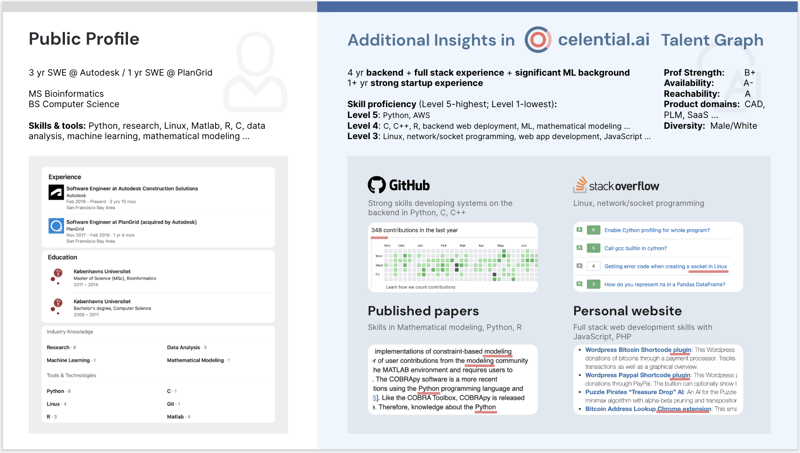
It’s often the case that people will only list “Software Engineer” as their job title on LinkedIn. Using the data insights we collect, our algorithm can reasonably determine whether someone is a frontend, backend, or full stack engineer, as well as their proficiency in relevant skills.
Taking it a step further, we can see the product domains they’ve worked in, their availability, and the likeliness they would respond to outreach. We can even tell right away their ethnicity for diversity search purposes.
Based on this information and how strong their professional experience is, we give a final grade on the profile that we use to accurately match to our customer’s job descriptions.
Need an engineer with Python experience?
Now, let’s see how deep our matching goes. If you are looking for a senior developer with 4 years of Python experience who would be willing to join your company, you might as well as be looking for a needle in a haystack.
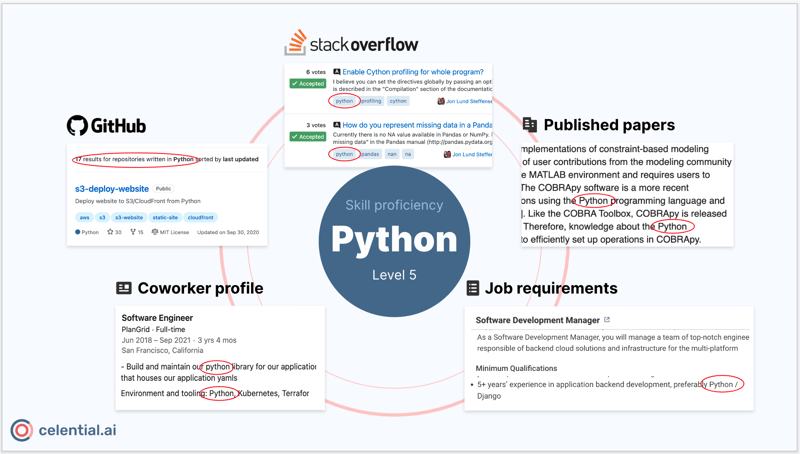
Well, in this same profile above that we found through our Talent Graph, we’ve ranked this person as level five in Python.
Here are the steps to determining that ranking:
1. Public data sources
Level 5 is our highest ranking and that is because we found he has GitHub projects in Python; he’s published papers that involved working with Python; he’s answered questions on Stack Overflow regarding Python. He has demonstrated expertise with the language based on several independent, publicly available sources.
2. Inference from co-worker profiles
And our Virtual Recruiter doesn’t just look at those signals from sources with his name attached to them. It looks at what this person has done at past jobs.
For example, this person worked at PlanGrid. His profile doesn’t show anything specifically about working in Python professionally, but we can deduce that he worked in Python at PlanGrid.
How do we figure that out?
To begin with, we know that this person specializes in backend development based on the publicly available data about them.
From there, our Virtual Recruiter has compared this person’s profile with other developers who have worked contemporaneously in backend development at PlanGrid, and found that some of them mention working in Python during their time there.
That’s a signal that this person has worked with Python in particular professionally.
3. Inference from job requirements
Further, in scanning the job descriptions that PlanGrid has available in backend development, it finds that PlanGrid requires candidates who have experience in Python. That provides yet another signal to our system that this person has experience in Python.
Other platforms like LinkedIn just see that this person has Python on their profile. It’s possible that means this person is an accomplished Python engineer, but it could also mean that their computer science courses in college were taught in Python and they’ve never worked in it professionally.
That won’t be enough to go on for someone who is looking for a senior engineer who can deliver in Python from day one.
What if you need an engineer with AWS experience too?
It’s rare that a senior role will only require someone who is strong with Python. Let’s say your job description also requires 2 years working in AWS infrastructure.
This might be rather difficult since the example profile doesn’t mention AWS anywhere.
However, the Virtual Recruiter will consider the other engineers this person has worked with, and the technical stacks of the other companies where they’ve worked.
From that, it infers that this engineer actually has significant exposure to AWS. Further, it knows that PlanGrid uses AWS for their cloud infrastructure, so this person is likely doing the kind of work that would require working with AWS.
How about someone who can work in Machine Learning?
To move even further down the verticality of our system, maybe you are looking for an engineer that can apply these skills to machine learning applications. Our talent graph has a broader knowledge base about Python to draw on as well.
For example, Python isn’t only used for backend development. It’s also used for data analysis, data processing, data infrastructure, and machine learning. There are related skills to Python for these specializations like PyTorch, Pandas, or Airflow.
Other platforms can’t tell that these skills are related to each other. They’ll treat Python and PyTorch as being as similar or as different as Microsoft Office and Financial Advising, because at the end of the day they’re just keywords to them.
We can generate additional insights because our talent graph knows, for example, that if someone has Python and PyTorch then they’re more likely to be working in machine learning.
All these insights hone the profile even more for better matching. If someone is using Python for machine learning, it’s less likely they’re using it to configure a web API.
So while someone might have, say, Python, Flask, and PyTorch listed on their profile, if our system sees that they have a more robust set of machine learning skills than back-end web development skills, it’ll prioritize them for machine learning roles.
Unparalleled Candidate Outreach
Our product isn’t limited to identifying matches between a role and a candidate.
Often, customers who have been working with us notice that candidates react more enthusiastically to cold emails sent by our Virtual Recruiter than to those sent by their human recruiters.
We’ve been asked to consult with internal teams on how to replicate our personalized emails. But so much of what makes our candidate outreach work isn’t teachable.
Why?
Because a human recruiter working with a tool like LinkedIn Recruiter just doesn’t have access to the deep insights into software engineers’ backgrounds that we do.
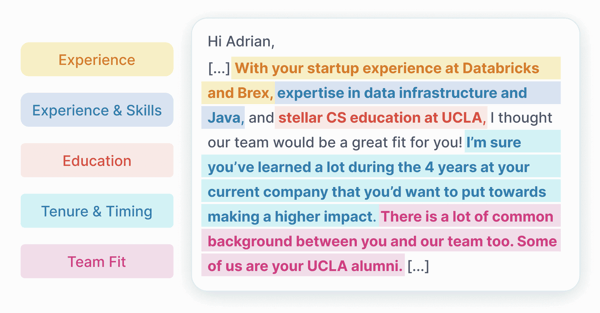
Hyper-personalization at scale
Our AI-generated emails are personalized for each match by drawing on our extensive candidate knowledge and make the case for why a given role would be a fit for them.
Someone could conceivably try to copy those insights by putting hours of research into each candidate to determine what will get their attention — but that can’t be replicated at scale.
After all, quality software engineers are in such high demand that no matter how good your outreach is, many won’t reply to cold emails simply because they’ve been made extremely comfortable where they already are.
However, we’ve found that so many of those exceptional-but-content engineers aren’t truly closed off to new opportunities. They’re just tired of reading emails that are clearly a stab in the dark, a soup of keywords that aren’t at all relevant for them.
Our personalized outreach can generate as much as a 30% reply rate for the developers we target. There’s no other sourcing solution on the market that can boast those response rates for passive candidates.
We have the tools to tell them a compelling story about why they’d make sense for the role our system has matched them for, and we can do it in a miniscule amount of time compared to what it would take a human recruiter.
Wrapping Up
Need more reasons why Celential is the best choice for your technical sourcing function? Here is a quick breakdown of what separates us from other solutions.
| Celential.ai | Other tech sourcing solutions(LinkedIn Recruiter, HireEZ, SeekOut, etc.) | |
|---|---|---|
| Type of solution | AI-enabled Virtual Recruiter (sourcing tool + recruiter 24/7) | Sourcing tool |
| Domain focus | Vertically optimized for technical recruiting with deep domain insights in software engineering, data science, and product. | Broad domain focus covering all professions. |
| Candidate matching | Accurate and efficient match with 360-degree mutual fit between candidates and job/team/company. | Quality is not guaranteed due to broad focus and generic understanding. |
| Candidate engagement | Hyper-personalized pitch emails created and sent automatically at scale. | In-house sourcers/recruiters to draft and send pitch emails. |
| Deliverables | Guaranteed pipelines of vetted and engaged candidates ready for interviews every month. Start receiving warm candidates in 3 days. | Often takes 2 weeks to 1 month for in-house team for implementation, training, and manual operations before getting a positive response from candidates. |
| In-house resources required | Minimal efforts. No new tools or workflows. | Dedicated in-house sourcers/recruiters to learn and use the tool. |
With all of that deep knowledge and at-scale outreach, Celential can deliver warm candidates ready to interview for senior software development roles within three days. Book a demo today and see how Celential can supercharge your candidate sourcing.
That means technical recruiters will continue to be busier and more in demand than ever as tech companies turn to them to find the strong, diverse engineering talent that they need.
What is tech recruiting?
Tech recruiting is the sourcing, screening and selection of candidates for IT or technical roles. Technical recruiters work with hiring teams at tech companies and startups to find talent who are a mutual fit and persuade them to accept job offers.

What is the difference between a recruiter and a technical recruiter?
A recruiter is someone who manages the hiring process for any type of open job role. They can be independent or part of a company’s Talent Acquisition department.
A technical recruiter is a recruiter who works on specialized, technical roles such as Software Developer, Product Manager or Data Scientist.
They need to be very strong in:
#1 Matching candidates to the specific needs of a tech company
Recruiters need to understand what software a company is using to build their products and the space in the tech industry landscape they occupy.
For example, a fintech company might need a Data Scientist with experience in credit risk modeling. On the other hand, a healthtech startup might be looking for a Data Scientist with a research background and Genomics experience.
Though both candidates might share the same title, their skill set and domain experience would be substantially different.
#2 Tech skills
Tech recruiters need at least a high-level understanding of coding to match potential candidates to jobs and evaluate their experience.
Which programming languages are up to date, and which are obsolete? What tech stack does a company use, and when can a skill like React be substituted for a skill like Angular?
Other hard skills like Boolean search (for finding potential candidates) and data analysis (for understanding candidate pipeline metrics) are also very useful in this role.
#3 Understanding and connecting with tech professionals.
The unemployment rate of 1-2% for Computer Science professions is a formidable challenge. Tech recruiters need to be able to connect with developers on a personal level, understanding what motivates them, and how they would fit into a company’s culture and team.
They can use this valuable information to sell opportunities from the very first outreach email to the final handshake on an offer (and sometimes longer).

What does a technical recruiter do?
A technical recruiter helps tech companies hire talent to fill roles. They collaborate with hiring managers; create JDs; source, screen and engage candidates; extend offers to candidates, and help develop a company’s overall recruiting strategy and hiring process.
#1: Collaborate with hiring managers
Hiring managers are typically subject matter experts with an ideal candidate profile in mind.
It’s the job of the technical recruiter to understand these preferences and requirements, but it’s also a two way street.
Recruiters also offer their perspective on the talent realistically available on the market and work with hiring managers to arrive at a set of requirements likely to produce successful hires.

#2: Create Job Descriptions
If you’re thinking of a Job Description as … well… a description of your job, a technical recruiter might beg to differ.
At least, it isn’t only a description of your job, but an advertisement highlighting company pitch points, exciting new opportunities and responsibilities, perks and benefits, as well as employer brand — crucial for attracting in-demand tech talent.
#3: Source candidates
With so few Software Developers unemployed and actively looking, proactively finding technical talent for your open roles is vital. Passive talent also has a lot of advantages — they’re pre-vetted by their current employer and you can proactively target talent who closely match the Job Description.
Tech recruiters can regularly spend 30 hours — over half their workweek — on sourcing potential candidates.
#4: Reach out to talent
Have you ever received an email that said, “Hi Name, I’m a recruiter and I’m looking for an Assistant Program Manager of Yoga Mat Manufacturing (Contract).
I saw your profile and thought you might be qualified for this position. Could you please reply with a resume, cover letter and three references by tomorrow at midnight?”
Yeah, we didn’t answer that email either.
Good technical recruiters are responsible for writing outreach emails technical talent will actually reply to.
#5: Screen candidates
Hiring teams and leaders will make the ultimate decision on whom to hire.
However, technical recruiters evaluate and assess candidates (particularly at the beginning of the process) to ensure they meet the basic requirements of the role.

#6: Close candidates
Technical recruiters are involved at the offer stage, extending offers to candidates and negotiating between hiring managers and talent to maximize the chances an offer is accepted. In fact, salary is typically partially based on the number of candidates they close.
#7: Develop recruiting strategies
Which Applicant Tracking System or sourcing tools should you use? How do you structure your interview process to showcase employer brand? What is your cost-per-hire and how do you improve it?
Great recruiters are thoughtful about their processes and data-driven, and their decisions have a huge impact on the overall success of your hiring process.
What skills do you need to become a technical recruiter? (Not all are technical!)
To become a technical recruiter, you need both the hard technical skills to match technical talent to positions and the soft skills to make a personal connection and sell candidates to hiring managers and vice versa. Let’s break down these categories.
#1: Technical knowledge
This includes:
- Roles and the range of skills and duties typically associated with them. Titles vary widely from company to company; a solutions engineer might be called a partner engineer at one company or an integration engineer at another. Conversely, engineers with the same title might have very different skills and experiences.
- Skills software engineers use. This is a prerequisite to understand jargon-filled resumes, including candidates’ proficiency in programming languages or particular software.
- Projects on a developer’s CV or resume. Technical recruiters need to be able to know how to gauge the extent and significance of developers’ work and contributions.

Source: arcaderage.co
#2: Commitment to candidate experience
In the wake of the Great Resignation and ever-persistent tech talent shortage, software developers are definitely going to consider whether you treat them well during the recruitment process. And, 91% of HR professionals agree that candidate experience improves quality of hire as well.
Effective recruiters make it a priority to:
- Create touch-points by communicating clear hiring timelines, feedback, and next steps so that candidates stay engaged in the process.
- Move quickly and keep up momentum and excitement to convert candidates to hires
- Write a timely and polite email to notify rejected candidates. Recruiters can also consider offering feedback, as rejected candidates are 4 times more likely to consider interviewing again if they do.

#3: Sales skills
Part of “selling” a company and opportunities to tech talent relies on identifying effective pitch points to use in JDs, outreach emails, and interviews. Recruiters can explain why a company is uniquely appealing by highlighting:
- Rapid growth and funding by top VCs
- The use of innovative technologies such as cutting-edge AI or ML
- A focus on making positive societal change, such as by helping small businesses or the environment
- Commitment to diversity, equity, and inclusion
- The backgrounds of leadership, such as having founded successful startups before
- Creative perks such as free yoga, gourmet snacks, student loan payments, WFH technology reimbursement, and company swag
The ability to craft a compelling narrative is also crucial to catch a candidate’s attention in a competitive labor market.
#4: Technical recruiter soft skills
Naturally, all the soft skills which make recruiters great are equally important to technical recruiting.
- Strong verbal and written communication skills
- Marketing and employer branding awareness (social media, job fairs, etc.)
- Familiarity with metrics and the use of data to track inefficiencies and improve the process
- Creativity in crafting appealing job descriptions and messages
- Organization, multitasking, and time management
- The ability to network and build relationships
- Adaptability, resilience, and persistence

Do you need a degree to be a technical recruiter?
Though a STEM background or engineering degree is an asset for a technical recruiter, it’s certainly not a requirement. 81% of technical recruiters have a bachelor’s degree, which means almost 1 in 5 tech recruiters has no degree at all.
So how do you do it?
How to get into technical recruiting with no experience: Five Tips for Recruiting Tech Talent
To get into technical recruiting with no experience, you just need to do a little research into the tools of the trade. That includes mastering the lingo, knowing where great talent can be found, and learning how to get their attention.
#1: Learning Tech Terminology
The first step is to gain familiarity with the landscape of technical roles software engineers can perform and the skills they require to be successful in each. Then you’ll be able to interpret a technical candidate’s resume or online profile and determine the jobs that fit them best.
One way to gain the lingo and upskill quickly is to read through online tech glossaries and technical recruiting guides and create flashcards with the most important technical terms.
You might also consider earning a quick certification from LinkedIn or Devskiller in technical recruiting.
Soon, you’ll find the difference between Java and JavaScript a breeze.

#2: Creative talent pools
While traditional methods like advertising on job boards and perusing career sites might work for less competitive nontechnical roles, you can gain an edge as a technical recruiter by spending time where developers do.
For example, you can find many software developers hanging out at GitHub, the most popular place to store code.

And don’t forget about Stack Overflow, a Q&A board with 14+ million registered users, for technical information and theoretical discussions about coding.
#3: Hyperpersonalized Messaging
It’s not easy to persuade great candidates to reply to your cold recruiting email, particularly if they are already happy at their current position.
However, we’ve actually seen startups beat out larger, wealthier companies for top talent.
The secret?
Tell candidates a personalized story about why they should work with you.
Woo them with your values. Explain how you fit into their career trajectory. Establish commonalities between them and members of your team.
We’ve found that this approach can result in a 30%+ response rate for tech talent, far higher than the recruiting industry average. For more tips and templates, check out our blog.
#4: AI Sourcing automation
Long gone are the days when recruiters had to individually read hundreds of resumes for a role or keep track of candidates in spreadsheets.
Automated solutions can help with job posting management, resume screening, candidate outreach, and more, eliminating manual, repetitive work.
And for tough, time-consuming tech roles that require specialized skill sets, you might consider a service like Celential.ai. Thanks to cutting-edge AI and ML, we deliver warm, engaged tech talent in just three days — freeing your team to focus on the meaningful, rewarding work of engaging and closing tech talent.
#5: Avoid Burnout
Busy recruiters can be particularly susceptible to burnout, as there’s always another candidate to find or email in the inbox to reply to.

Recruiters need to have open and honest conversation with managers about realistic delivery times and where to focus efforts.
Bandwidth is not unlimited. Which roles are truly important to the success of your company? Which roles are fillable quickly? If a hard-to-fill job is taking up all of a recruiter’s time, all of their other placements will suffer.
Technical recruiting FAQ
Is tech recruiting a good career?
Yes, tech recruiting is in fact a great career. You get to meet startup entrepreneurs and cutting-edge engineers and learn about the latest, most exciting technologies. As recruitment is commission-based, you can scale your efforts up and down depending on your priorities and work-life balance.
Another huge perk of being a tech recruiter is sharpening skills — like communication, sales, negotiation, marketing and data literacy — that will set you up for success in a host of other careers later.
Is technical recruitment hard?
It’s true that technical recruitment can be hard, and it may not be for everyone. Here are some of the main reasons why:
- Frequent failure. For every candidate that receives an offer, dozens more are rejected — and it’s often your job to convey the bad news.
- Competing interests. Recruiters don’t just have to convince a hiring manager to say yes — they also have to convince the candidate.
- Specialized roles. Technical recruiters often work on competitive roles with a specialized skillset. It’s not always easy to find a top-quality Senior Go Developer with cloud infrastructure experience willing to work in-person in Atlanta…let alone fifty of them.

Source: ongig.com
Do tech recruiters make a lot of money?
According to Glassdoor, the average Technical Recruiter makes $83,960 in total compensation — but the numbers can vary significantly due to commission-based pay.
With 10-14 years of experience, a Senior Technical Recruiter earns $135,942 on average in the United States.
Are technical recruiters in demand?
Yes, tech recruiters are currently in demand. Despite economic turbulence due to the pandemic, global upheaval, supply chain woes and interest rate hikes, the tech talent market hasn’t cooled much — if at all.
As a result, companies continue to need tech recruiters to help them navigate the large and ever-growing tech talent shortage.
With tech recruiter job postings growing 3X since the start of the pandemic, it’s safe to say tech recruiters are in high demand.
Get AI on your team to supercharge your tech recruiting
Celential’s AI-powered sourcing solution delivers high-quality and engaged talent with zero effort or learning curve on your part — lightening your talent acquisition team’s workload and freeing up their time to nurture tech talent and close hires.
3-Day average turnaround with warm talent ready for interviews appearing in your inbox or ATS in 1-5 business days.
80% average acceptance rate of tech candidates for competitive, specialized roles like Fullstack, Backend, Frontend, Data, DevOps and Machine Learning engineers, Tech Leads, Architects, and Managers.
Instant flexibility to scale up and down your recruitment efforts as your hiring needs, role priorities, and budget shift during these uncertain economic times.
]]>Celential’s VP of Sales Brian Hollinger originally identified and contacted Whit through Celential’s Virtual Recruiter solution. We sat down with the two of them to discuss both sides of the experience with Celential’s sales recruiting technology and to get Whit’s thoughts on Celential since joining.
A search for only the best enterprise SaaS sales talent
Brian, what kind of past sales experience requirements were you looking for when you began the search that ultimately led to hiring Whit? Were you looking for expertise in any particular types of sales, or any metrics pertaining to company size, industry, region, and history with specific products?
Brian: In general, I was looking for people who demonstrated consistent achievement in sales roles. And beyond consistency, I wanted to identify people who could overachieve on the goals given to them.
More specifically, I was looking for people that had experience closing deals similar to our own deal size. I didn’t want someone in an SMB sales role, and I didn’t want someone without a history of selling software or working in the tech industry.
I wanted someone that was already working in a true enterprise SaaS sales role where they were selling a product that had an impact on business outcomes equal to our own. Most importantly, I wanted to see a track record of success over a number of years in that field.
An AI solution that immediately uncovered the most relevant candidates
How quickly did you start getting traction on your candidate pipeline for this search? How was the candidate quality in using Celential’s Virtual Recruiter solution? Amongst those candidates, what made Whit stand out as someone to interview for the role?
Brian: I started getting candidates right away, and I was getting quality candidates consistently. I was typically getting about 20-40 candidates a month through the solution who had enterprise software sales experience.
That was the most important thing for me – I needed a consistent pipeline of top candidates that were open to a discussion.
When I first saw Whit presented in my ATS, his profile stood out because he had experience at well-known tech companies and a track record of sticking around at those great companies. I didn’t want someone with a history of staying a year or less at their job even if it was at a company I respected.
Whit had a strong history of staying for multiple years at top companies, and that demonstrated to me that he could succeed over a long period of time at Celential.
The products and services he was selling also had a deal size comparable to the deals we close, which was also a strong signal that he wouldn’t need a large ramp-up period. And I ended up being right! Whit’s been delivering practically since day one of joining us.

Additional insights from our sales talent graph beyond public candidate profile
The one cold recruiting email that stood out from the rest
Whit, where were you in your career when Brian reached out to you? As a salesperson, what about the pitch regarding Celential stood out and made you want to interview with Brian?
Whit: I had been at my previous company for about three years. I’d hit some important milestones there but had reached a point where I felt like I couldn’t go any further, so I was considering making a change.
But I was also pretty established in my sales career at that point, so I was only open to compelling opportunities that I truly believed in. And, honestly, I wanted to work at a startup where my contributions would be recognized and have an impact on the growth of the business.
There were a couple of things that jumped off the screen for me when I first saw Brian’s message in my inbox. There was a match on the size of the deals he was talking about with the size of the deals I was used to closing.
All the other recruiter outreach I was receiving talked about very generic metrics that made it hard to envision a future with the company they were talking about. He also talked about Celential’s sales cycle, and it sounded like something that was really unique and would offer me the great potential to hit the ground running if I joined.
Most importantly, Brian’s email read like he had done his homework on my career. It really sounded like he understood where I was professionally and what I’d accomplished to this point.
Again, other recruiting emails tend to be pretty vague on that – they’ll often tell you that you’re a top candidate, but they’ll almost never offer a good reason why.

Celential’s first email to Whit
The first impression that set up for an amazing candidate experience and eventually a key sales hire
What was your reaction when you learned that Brian hadn’t handwritten the email to you, and that it had actually been written by an AI?
Whit: When he mentioned that I was experiencing Celential’s platform right now while reading that first email, I’d just assumed that meant he’d used Celential to identify me from a candidate pool. I’d never have guessed that he was referring to the actual message he’d sent me as well!
So it definitely wasn’t something that I saw coming. It’s usually pretty easy to identify sales recruiting emails that weren’t written by a human because they give a dry pitch about joining a fast-growing team and having a competitive commission.
In comparison, I really got the sense that Brian had thoroughly reviewed my background and had come up with several specific reasons why he wanted to reach out to me.
Learning that was proof of concept for me on Celential’s product, and I was intrigued to continue interviewing from there.

Whit and Brian at sales team off-site
Where do you see Celential’s position relative to the market on recruiting solutions? In the end, what made you believe that Celential was where you wanted to be?
Whit: It’s definitely a cutting-edge product that takes a unique approach to sourcing. There aren’t many solutions that are using artificial intelligence to scale sourcing in this way that takes all the work out for the recruiter.
It dramatically improves productivity compared to other tools that still require you to decide manually if you want to reach out to a candidate and then craft that message yourself.
A lot of the traditional resources that it competes with–most notably, recruiting agencies–are pretty expensive. So you not only get the increased efficiency pound-for-pound in identifying and contacting candidates, but you get a lower cost-per-hire because the service itself isn’t priced around the eye-popping commissions that often come with recruiting top tech talent.
I also think it’s notable that costs-per-hire are relatively fixed compared to contingency fees.
I’d say Celential is unique enough to be called disruptive, and I wanted to be part of something that I could see exciting companies making significant investments in.
What’s next
Whit recently closed an important deal and his sales pipeline is expanding every day. His future managing Celential’s territory in the South and the Midwest looks bright.
If you’re interested in identifying and recruiting top Account Executives, Business Development Representatives, Sales Managers, or Sales Engineers working in tech, schedule a demo with Celential today!
]]>
For recruiters who still have open software engineering roles, the current economic turbulence has made hiring a software developer incredibly difficult.
Many aren’t willing to change companies until the dust settles. And with fewer resources, it is hard for many talent acquisition teams to fathom shelling out tens of thousands of dollars to an agency to recruit one.
However, by examining and optimizing your processes, it’s still possible to source enough passive software developers, meet your hiring goals and close out the year strong.
We asked our Customer Success Lead, Stephen McReynolds, a Marine Corps veteran and Stanford grad, for advice on how to do just that.
Based on his extensive experience helping seed-stage software development companies and startup clients make fast and quality hires, Stephen breaks down how to calculate your company’s true, complete cost to hire, taking into account all of the factors that matter.
In this definitive guide to calculating (and improving) your cost to hire a software developer in 2022, we’ll also dive into the concrete strategies you can use to reduce your recruiting costs without compromising on quality.
How much does it cost to hire a Software Developer?
As a basic benchmark, here are a few numbers that make it clear hiring a software developer is largely expensive, slow and difficult — and the situation is only getting worse.
A few numbers:
- Nearly 1 million unfilled IT jobs remain unfilled
- Demand for software developers will grow 22% from 2022 to 2030, according to the US Bureau of Labor Statistics
- Unemployment rates hover between .1 and .6 percent for software developers
- It takes an average of 35 days to hire a software engineer
- 86% of technology leaders say it’s challenging to find technical talent today

Let’s take a look at the specifics of your options for hiring a software developer and exactly how much it costs.
How much does it cost to hire full-time software developers?

| Recruiting Costs | $66,000 (calculation below) |
| Pros | Deeper understanding of your team’s projects, processes and culture Often have more experience seeing significant long-term projects through end to end |
| Cons | Higher upfront recruiting costs and longer time-to-hire More legal complexity and financial commitment |
How much does it cost to hire freelance developers?
| Hiring Costs | Toptal: $75-250 total per hour (platform fees included in hourly rate) Upwork: $15-75 per hour, 5-20% service fee, and “fully loaded” costs of screening freelancers Fiverr: costs are per project, starting at $5 with a 5.5% service fee paid to the platform |
| Pros | More flexibility to scale your team up and down Freelancers cover their own benefits, taxes, and other costs |
| Cons | High hourly rateLess integrated into the culture of your team |
How much does it cost to hire an agency?
| Hiring Costs | 18-35% of the candidate’s first-year salary |
| Pros | Recruiting agencies aim to employ experienced recruiters with technical knowledge. Since compensation is based on results, agencies are very motivated to find candidates. More flexible to turn on and off than an in-house recruiter |
| Cons | Typically the most expensive option, as fees are on top of the time and money you spend interviewing candidates Unscrupulous agencies may flood you with unqualified profiles in the hopes that something sticks |
How to calculate the cost of hiring a Full-time Software Developer?
If you’ve never sat down and run the calculations, you might be surprised at how many factors add to the cost of hiring a software developer.

“I use the term ‘fully loaded costs’ for all of the overhead on an employee-by-employee basis that goes beyond salary,” Stephen McReynolds explains.
“Relevant overhead includes, for example, benefits and the cost of recruiting technologies. It also includes broader structural costs like office space and non-recruiting-specific technologies like Zoom or G-Suite.”
To hire a full-time software developer (full-timers make up roughly 81% of all developers), you’ll need to consider the costs of sourcing, recruiting, coordinating and interviewing.
Stephen breaks these categories down using example numbers from a startup, which we’ll call “Precisionly.ai”. In a three-month period, Precisionly.ai made three hires for their software development roles.
Sourcing
“Sourcing is the outbound activity of identifying, qualifying, contacting, and nurturing candidates to persuade them to have a conversation with you,”
Stephen said. “When done correctly, all sourcing activities — and no others — should be factored into this cost bucket.”
The sourcing function can be performed by sourcers (specialists), recruiters (as one of many general recruiting tasks), and third-party resources (agencies, RPOs).

Nearly half of recruiters reported most of their workweek — at least 30 hours—on sourcing.
Including compensation for sources and subscription fees for sourcing tools and technologies, Precisionly.ai spent an average of $10,000 per month on sourcing.
Recruiting in house
What’s the difference between sourcing and recruiting?
“Sourcing is a subset of recruiting. While recruiters often spend time sourcing, especially at startups or on leaner recruiting teams, many recruiters focus on activities after a candidate has been initially engaged,” Stephen said.
These activities include screening, selling, and influencing the candidate, researching compensation and comp plans, and helping to close candidates.
So how do you add up all these activities?
You multiply their monthly “fully loaded” recruiter compensation by the percentage of time from the month they devote to just recruiting (and not sourcing). Then you add on the fees of all recruiter tools and technologies they use in that process.
After all, was said and done, Precisionly.ai had monthly in house recruiting costs of $12,000.
Coordination

Recruiting Coordination ensures a seamless candidate experience for scheduling and interviews.
This category includes the full costs of employing and utilizing a recruiting coordinator — as well as any additional admin time taken on by other parties such as executive admins and office managers.
For Precisionly.ai, that came to about $3,600 per month.
Interviewing
Interviewing for software development roles is an arduous process, and typically involves both a technical and culture assessment by engineering team members and leadership.

“In my time at Celential, I’ve seen processes as short as two interviews and as long as seven, with many people engaged throughout that process,” Stephen told us.
“For early-stage companies and those who emphasize candidate experience, interviewers may include senior leaders as high as the C-Suite. The cost of this is difficult to measure but is a combination of the “fully loaded” cost of their participation, as well as the opportunity cost of what they could/would have spent the time doing otherwise.”
Precisionly.ai’s costs came to around $40,400 each month. That included:
- Technical Screen with a Senior Engineer (including wage, overhead, and lost engineering hours for interviewing as well as write-ups and feedback)
- Virtual Onsite with a Senior Engineer, CTO, Hiring Manager, and Product Manager
- Issuance of Offer Letter by the Hiring Manager

Software Development Hiring Costs: Example Calculation
For Precisionly.ai, the total cost of hiring three developers over three months was:
| Sourcer Salaries & Tools | $30,000 |
| Recruiter Salaries & Tools | +$36,000 |
| Recruiting Coordination Costs | +$10,800 |
| Interviewing Costs (for 200 candidates) | +$121,200 180 tech screens = $36,000 75 onsites = $82,500 9 offers = $2,700 |
| Total Costs over 3 Months | = $198,000 |
| Cost per hire | = $66,000 |
That comes out to $66,000 on average to hire a software developer.
And that’s before you even start to think about annual salary and benefits, which are at an all-time-high and rising.
How to reduce the cost of hiring a Software Developer in 2022?
If you need a full-time software developer but are facing eye-wateringly high recruiting costs, we feel your pain. Here are some concrete strategies for reducing your recruiting overhead.
Upskill your current workforce
Particularly in the midst of a raging talent shortage, upskilling can be much more cost-effective than hiring someone new.

Research from the Wharton School of Business shows that, on average, external hires cost 18-20% more and perform worse for the first two years on the job.
And, it’s something that employees really want — boosting morale, productivity and employer brand.
For example, a non-technical recruiter on your team can learn to source for technical roles by consulting resources like our technical recruiting cheatsheet or complete guide to sourcing software engineers.
Tips for companies looking to upskill or reskill their employees:
- Encourage employees to set concrete goals with a timeline, and check in on progress regularly. For example, instead of “learn basic coding skills”, consider “In Q3, complete 500 lessons on Free Code Camp, complete two projects, and pass one online community college course.”
- Promote a less hierarchical culture and shift away from distinct job grading to create more opportunities for learning and development. For example, a job rotation program can help employees pick up new skills — they’ll either bring back this knowledge to their current role or grow into a new one.
- Mentorship programs can benefit both newer and more experienced employees, as they gain professional competency and increased leadership capability respectively.
- If you have a good number of employees whom you’d like to train on a particular set of skills or technologies, consider implementing an in-house program customized to your team’s needs.
Be flexible on location
Expanding your hiring radius allows you access to far wider software development candidate pools — like Pittsburgh, Atlanta, Chicago and Miami, the four fastest-growing tech hubs of 2022.

Many startups are hiring full-time developers from other countries. The advantages of a globally distributed software development team include round-the-clock coverage, increased diversity, and reduced costs for office space.
LATAM software development hiring
In particular, Latin American tech hiring has exploded recently as a particularly advantageous alternative for US software development companies. Besides weaker currencies and a lower cost of living, the region also shares similar time zones and culture.
Many recruiting services and tools are still limited to the US. If you’re looking to scale your software development team with top Latin American developers, Celential.ai’s service can help, with a talent graph of 10M+ engineers across Latin America, the US and Canada.
With remote work’s popularity among developers (75% want to work from home most or all of the time) it can truly be a win-win — especially if your budget is tight but you don’t want to compromise on candidate quality.
Analyze your Recruiting Process
By tracking your metrics — such as cost-to-hire or offer acceptance rate — you’ll be able to identify and keep the best ideas and quickly discard those that don’t work.
For example, if you try outreach messaging version A and version B, and version B performs 20% better, that translates to significant productivity gains over a month of outreach.

Data can also help you to identify bottlenecks and streamline your recruitment process.
If 30% of software development candidates disappear when you request a resume prior to an intro call, you might try asking for the resume later in your recruiting process, or perhaps not at all, to minimize the chances of losing exceptional developers.
Reassess ROI of external partners and tech tools you’re subscribed to.
With a little analysis, companies can judge which resources actually impact your hiring targets. Spot an ineffective expense? Cut it and you can optimize your budget with minimal pain.
- External staff agencies and contracted recruiters are expensive – costing 18% to 35% of a candidate’s salary per hire. If they haven’t produced results in months, it’s time to cut them loose.
- Job board subscriptions can cost up to $1000 per month to post just five jobs, and if you aren’t finding qualified developers then that is lighting money on fire.
- An internal recruiter or sourcer is compensated $80,000+ a year on average, in addition to the “fully loaded” costs of interviewing and onboarding. And, they’ll take a couple of months to fully ramp up. It might be best to invest that money in solutions that can produce 20-40 top quality candidates per month.
Improve Candidate Experience
Candidates who exit the hiring process represent lost opportunity as well as a significant burn of invested time and cost.
And in today’s competitive software development market, candidates are evaluating you just like you’re evaluating them. How you treat them during the hiring process is definitely going to impact their decision to join you.

So what do candidates care about?
- Communication — never leave developers hanging about what comes next and when they will hear back from you. Failure to communicate is the number one pain point for job seekers and will prompt busy developers to explore their many other options — the ones who aren’t ignoring them, for example.
- Speed — a streamlined, fast-moving hiring process will keep in-demand developers engaged (and signal that you respect their time). If possible, aim for no more than 3-4 rounds total.
- Personal connection — more than half of employees actually care more about culture than salary. Genuine interest and remembering personal and professional details to reference later will go a long way in persuading developers to accept your offer.
- Accessibility — ensure diverse candidates have easy and equitable access to applications and any interview accommodations they need.
Strategic Use of Technology for Hiring Software Developers
When talent acquisition budgets are squeezed by economic uncertainty, technology like AI sourcing solutions can take over some of the repetitive tasks that people waste time on day-to-day — multiplying your recruiting team’s efforts.

Consider the use of AI for:
- Job posting management
- Intelligent sourcing and candidate procurement
- Recruitment marketing campaigns and data analytics
- Candidate outreach
- Email lookup tools
- Resume screening
- Automated interview scheduling
- Applicant tracking systems
How to reduce your software developer hiring costs with AI technology
One specific example of a company using AI technology to reduce the time their recruiters spend on hiring a software developer comes from our customer Heartbeat Health.
Heartbeat Health is a Virtual-First cardiology solution revolutionizing the delivery of cardiovascular care. Having raised a $20 million Series B, Heartbeat Health wanted to accelerate their product delivery but faced a talent shortage.
With fit being critical for a small, hypergrowth startup and the clock ticking to keep up with the demand of their thousands of patients nationwide, Heartbeat initially turned to recruiting agencies for support. However, the developers presented to them hardly ever had the qualifications to succeed at Heartbeat.
After failing to make substantial engineering hires with traditional recruiting methods (such as those used by Precisionly.ai), Heartbeat investigated more modern sourcing techniques and came across Celential’s artificial intelligence approach.
The results? “Celential is one of the best investments in recruitment we’ve ever made,” said Bella Ratner, Heartbeat’s Head of Talent.

| Total Hires | 4 Hires – Frontend, Backend, DevOps & Data |
| Time Frame | 3.5 Months |
| Warm Candidates Submitted | 29 per Month |
| Pricing Structure | Flexible, with the ability to scale up/down and shift priority roles based on hiring needs |
| Sourcing Accuracy | AI-enabled talent sourcing uncovered the best mutual-fit candidates, matching skill, product domain, and team fit |
| Customer Support | Dedicated customer support integrated with Heartbeat’s workflows and reduced recruiting coordination overhead, freeing up Heartbeat’s recruiters to engage many more candidates |
With a talent graph of 10M+ software engineers and hyper-personalized candidate outreach, Celential.ai was able to find and engage many passive candidates traditional agencies couldn’t.
Due to more accurate sourcing, Heartbeat was also able to reduce their time to hire by eliminating the time their recruiter’s spent on finding qualified candidates and cutting out many unnecessary and costly interviews.
This time saved significantly reduced their cost to hire for each software engineer and created a better candidate experience because their internal team had more time to build relationships.
Hiring in a recession, especially for hard-to-fill specialized roles, is no easy feat.
Request a demo to learn how Celential.ai can help reduce your costs to hire by up to 30%.
]]>He has a record of success in research advancements at LinkedIn and Microsoft, as well as leadership experience in AI at multiple startups.
We chatted with Xu about the path that brought him to Celential, including his initial encounter with Celential’s Virtual Recruiter Service. From there, we discussed Celential’s highly vertical, “white box” approach to AI, and how the collaboration between human experts and AI can accelerate the development of AI solutions to recruiting problems.
What drew you to computer science as a field in the first place, and what led you to pursue AI in your graduate work?
My undergrad actually wasn’t in the field of computer science at all; I was an electrical engineering major. It is a mixture of physics, hardware, and a little bit of software.
But after graduation, I figured out I was not a hardware person. I can hardly assemble a radio. So I decided that I’d pursue a career in a software or a mathematically-oriented field. That’s where I started to do computer science work.
The mathematics for AI are quite similar to the mathematics for the physics on the electrical engineering side, and it was easier for me to pick up the theory and the practice for AI.
That’s where I started to feel like “Oh, I’m connecting with this,” and I just went down the rabbit hole for many years.
There are two major shifts that you’ve undergone as a professional. First, you went from being in academia doing visiting scholarships and postdoctoral work to working in industry at larger organizations like Microsoft, LinkedIn. Then you went from larger companies to being a co-founder and now a VP in a Series A startup. Could you tell us about what inspired both of these shifts? What drew you from one place to the other, and what do you find similar and different about them?
In general, I think all three environments are very challenging, and while they’re very different, they share one thing: they want to innovate. I’ve always been motivated by innovation, so I’ve pursued innovation in different forms throughout my career.
After I got my PhD, I was waiting for opportunities in academic positions. But innovation is everywhere. It’s not just in academia.
I found out that Microsoft opened up a secret project on computer vision using the second generation Kinect camera. It was part of their research branch’s incubator program that pushes research work into real products.
That’s the part that immediately resonated with me. So I joined Microsoft to follow this path.
After a couple years in a large company, I realized that if you really want to create something completely new, you better go to a startup. That’s not to say that big companies don’t create new things. But they rarely take on a project that’s less justified for the value.
They act more as a steward for ideas where you just need to figure out the technical part.
If you want to go to the front line and test something out, then that’s the realm of startups. A lot of things–even with, say, deep learning–come from startups. Like DeepMind–they beat that Go master with AlphaGo and then they got acquired by Google.
That’s how startups contribute to innovation in the industry. And that fascinated me for a while, and I started my journey in startups and I haven’t turned back yet.
Let’s talk a little about your experience encountering and then later joining Celential. What was that initial outreach from Celential like? What eventually led you to sign on with Celential?
It’s an interesting story. I found out about Celential when I was contacted by their CEO, Andrew Dong, through their AI system about a position for one of their early customers.
I was impressed by the personalized email for a couple reasons. He spoke about my prior work, and pitched the idea of building something that could change people’s lives. The outreach was quite touching compared to the more bland emails recruiters often send.
I immediately replied to Andrew to set up a meeting.

But the timing wasn’t right to leave my role at the time, so Andrew and I became friends afterward instead. He even became an advisor for my company on business interactions and product direction for a couple of years.
That role didn’t ultimately pan out, and I felt like I needed to find something new. So I talked to the team at Celential. I felt certain that it was a really good place. There were a lot of smart people who were very dedicated to fulfilling their mission. I got along really well with the team in the interview, so I decided to join.

The first version of Celential’s talent graph and virtual recruiter product had been developed by the founding team by the time you joined, but since then you’ve worked to level up these products significantly. What previous experiences did you draw on in this work?
Well, most AI companies are building systems that are built as ‘black-boxes’. The GPT-3 model by Open AI is a well-known example. They don’t need a domain expert to check it at all. They just feed massive data into the AI algorithm and extract interesting outputs based on correlations of data features.
They have shown marvelous achievements on open domain problems, but still quite far from providing solutions in deep verticals or specific challenges because it’s difficult to evaluate or to speed up the machine learning and improve the technology so that it can still fit into the vertical.
I believe the fastest way to adapt the latest AI models to a vertical domain is through the ‘white-box’ or ‘open-box’ AI technology. That was what I was developing before joining Celential.
That approach seeks the answers to problems the black box approach doesn’t concern itself with. Problems like how you explain what the AI’s actually doing, or how you encode domain knowledge into the AI algorithm, or how you get the AI model to reason more like a human with domain expertise.
And that’s the reason I wanted to join Celential: I believed I could bring that value to their talent graph. That’s our focus of the data team — enabling human experts to train the AI efficiently and effectively by utilizing their domain knowledge.
For example, to source software engineers, you need an incredible volume of specific data about their skills and professional trajectory. This specialized data can come from professional communities, personal websites, company profiles, and places where software engineers talk to each other online.

Celential was already able to capture this data via the talent graph before I joined, so my role is to feed our AI that data and tune the model as if it were a high performance car engine.
With this engine running on that specialized data and our engineering team tuning it to reach peak performance, we developed an AI that can think proactively about people’s career paths.
Our AI can even predict the likelihood that a strong senior software engineer or tech lead would be ready to be an engineering manager in their next job, or how likely someone will want to move from a larger to a smaller company or vice versa in their next role.
It will then match that person to an open role from one of our customers.
These are the kinds of advancements we can make by going deep into our vertical, and they’re often the situations that expert recruiters face everyday but can’t perform at scale.

With that vertical, white box approach to AI in mind, what is Celential’s unique value add as a recruiting solution? What is Celential bringing to the market that something like LinkedIn might not be bringing?
I think that LinkedIn Recruiter has a different direction. They’re trying to address something broader, trying to reach a broader market rather than focus on verticals.
They’re trying to say “Okay, we’re going to take on all recruiting problems, we’re going to take on all kinds of roles, from the technical, technology-driven roles to, say, chefs.”
And that makes the AI solution or algorithm harder to refine because it’s so broad. You can only scratch the surface, and in the end the candidate matching quality cannot be guaranteed. So the hiring company has to use a human recruiter to use their solutions.
Although it does help the recruiter to get better candidates, it’s not a fully automated process. You still need a lot of human involvement in that process.
But our virtual recruiter solution takes a different route. We don’t want to address the broader market, we want to address the software development vertical.
That’s the mission that we have. Because this is a vertical domain, I believe the collaboration between domain experts and the AI algorithm will speed up the development of the AI system.
At the end of the day, I think we can create an end-to-end automated solution and user experience for the hiring company, one that has both a lower cost per hire and a more streamlined process for hiring.
Interested in learning more about how Celential is solving companies’ tech candidate sourcing challenges with Artificial intelligence?
Schedule a demo today!
A volatile market creates plenty of opportunities, sure. But it can also create a chaotic screening process, due to the sheer number of applicants and/or roles available.
Recruiters and talent acquisition teams also want to make sure they are providing their talent pipelines with the best, most relevant passive talent to close top in-demand roles like software engineers faster.
It’s here that candidate sourcing software comes in. Without software support, talent teams can spend over 30 hours a week sourcing candidates on job boards or LinkedIn.
And in an increasingly competitive talent environment, the company that can source top candidates the most efficiently can create a better candidate experience and fill more vacant roles.
Which of the many sourcing software options will give your talent teams an edge?
Here we compare the 12 best candidate sourcing platforms you can utilize when hiring software developers and other in-demand tech roles.
What is candidate sourcing software?
Candidate sourcing software is designed to help recruiters, hiring managers, and talent acquisition teams identify relevant candidates across a broad source of networks and communities.
Key features of candidate sourcing software include finding, screening, and even contacting potential candidates all from one central platform.
This can be a total game-changer for busy hiring teams.
Every business, and team within it, should be looking to work smarter in 2022. Organizations are facing tightening resources due to the economic crisis, and a digital transformation of previously manual tasks is one way to work more efficiently.
McKinsey even believes that digitizing information-intensive processes can cut costs by 90%!

Traditional candidate sourcing workflows are indeed information-intensive. Talent acquisition teams can spend large chunks of time trying to find the best talent on job boards (such as Reed or Indeed), social media sites (LinkedIn), and reaching out to their network simply to compile a handful of relevant CVs.
Often that work will see little ROI, with 3 out of 4 CVs being unqualified. This all highlights an obvious need to source candidates more efficiently while the odds are so heavily stacked against the more traditional methods.
How do you choose the best candidate sourcing software?
Before we dive into the 12 best in detail, it’s worth considering the following questions for your team, business, and the work that you carry out.
What specific talent challenges is your team facing today?
For a candidate sourcing software to be most valuable, it needs to fill the gaps or problem-solve the challenges you’re facing today. Most importantly it should automate your most time-consuming manual recruiting processes. Is a lack of local candidates an issue? Are the job boards you are using not producing enough quality candidates?

Do you want to build your remote workforce across the country? Do the top job openings on your career page receive any applications?
The wider reach made possible by candidate sourcing software will result in significantly more tailored resumes, whatever your recruitment goals.
Are there any particular features the software must have?
This builds on the above. As well as facilitating specific recruitment objectives, different software solutions will offer different features.
Do you want to put hyper-personalized candidate engagement on autopilot? Is it imperative that the software integrates with your Applicant tracking system?
Sourcing passive talent demands a different workflow versus engaging active job seekers, so make sure the software you select can support your needs.
Does the software fit within your budget?
The cost of sourcing software should always be a consideration. It’s not uncommon for SaaS recruitment tools to offer multiple tiers and ways of paying, e.g., monthly vs. annual, so browse your options carefully.
You may also want to consider adjusting your recruiting budget to make room for the technology. That means canceling your subscription to the job boards you are currently using.
How long will the software take to learn?
This is a critical indicator of how useful candidate sourcing tools will be for your organization. If you’re looking at a weeks-long onboarding process or having to specifically upskill your talent teams in order to use it, you might be better off looking for a more user-friendly solution.
12 best candidate sourcing software for 2022
Let’s get into it, shall we? The software solutions below all have the potential to assist recruiters and talent teams when it comes to automating and streamlining the candidate sourcing process.
Passive candidate sourcing software
Celential.ai

Celential’s passive candidate software solution requires no effort from the talent acquisition team to use and can scale up or down depending on your hiring needs.
Companies just need to sign up, give Celential their open roles and they will start receiving 10-20 qualified candidates for each role to interview within the first 30 days.
It draws from a unique Talent Graph of over 15 million software engineers and tech sales professionals from the U.S, Canada, and Latin America, giving it one of the widest reaches on the market.
Most importantly, it uses AI and machine learning technology to create more complete candidate profiles and more accurate candidate matching than traditional candidate databases.
Once the best talent matches have been identified, Celential’s AI Virtual Recruiter is set up to contact them at scale, with highly personalized messages that speak to mutual fit and stand out from the general recruiting messages top passive candidates otherwise receive every day.
Celential: Wins
- Rapid candidate matching to job descriptions for top talent.
- No barrier to entry.
- Average of 3 days for receiving highly experienced, relevant candidates — Celential users have experienced an 80% in time-to-hire.
- Helps free up TA teams to promote candidate engagement, candidate journey, and integration while delivering a 50% saving on average talent acquisition costs.
- Promotes employer brand through personalized and timely touchpoints.
- AI proactively targets underrepresented groups to improve diversity hiring.
Celential: Potential drawbacks
- Designed to help with multiple roles simultaneously, not one-off hires.
Celential: Pricing
- Request a demo or sign up for a free trial to learn more.
What to ask during a passive candidate sourcing demo?
Want to know if Celential is the right candidate sourcing software for you?
Here are the questions you could ask the team during a platform demo.
- How long would implementation take for our particular situation?
- Do you have any comparison data for hiring passive candidates vs. active candidates and for using AI-powered recruitment vs traditional methods?
- How would you recommend introducing staff to the software and training them to use it?
- What ROI do you see within businesses implementing your software?
Candidate sourcing tools
The below sourcing tools are standalone applications built to be versatile and adaptable enough to integrate with other widely used platforms. That said, they often have a slight learning curve and require extensions or add-ons to be installed to reach optimal efficiency.
Some specialize in finding passive candidates while others tap into social media and their own talent pp to find active candidates.
Yello

Yello is predominantly an early talent recruiting platform that focuses on helping organizations fill entry-level roles. It’s no secret that hiring straight out of college or university can be a huge benefit in tech roles, and Yello can automate the process of finding the best new graduate talent.
It streamlines resume collection, candidate liaising, interview scheduling, job offers, and more.
Building on its original early talent proposition, Yello now also offers sourcing tools for finding more experienced job seekers and leveraging diversity hiring.
It still offers all the same features listed above.
Yello: Wins
- Specific feature sets for early talent recruitment both on-campus and virtually.
- Facilitates the organization of in-person and virtual campus hiring events.
- Integrates with ATS and assessment systems.
- Provides a range of helpful resources, including a recruitment event ROI calculator.
- Deployable in Cloud, SaaS, and web-based environments.
Yello: Potential drawbacks
- Focused on early talent recruitment, which might not be the focus of your recruitment efforts.
- Its database of 6 million students and recent graduates is smaller than other, less niche databases.
Yello: Pricing
- Pricing available upon request.
Fetcher

Fetcher is part of the category of sourcing tools that automates the candidate selection process, continuously working away in the background to ‘fetch’ qualified candidate profiles for talent and hiring teams.
The sourcing tool gathers together batches of profiles, presenting back easy-to-read, up-to-date information on a list of candidates. Fetcher pursues active talent profiles to build a clear picture of the market and then uses that information to offer personalized engagement to appropriate candidates.
Recruiters can also manually add candidate profiles to their Fetcher list via the software’s one-click Chrome extension.
Fetcher: Wins
- Well-qualified candidates are consistently sent in batches to save recruitment teams time.
- Adaptable to suit the hiring needs of most businesses from start-ups to enterprise level.
Fetcher: Potential drawbacks
- Some users report difficulty in finding candidates for specific technical roles.
- Prefab email templates make it difficult to personalize outreach.
- Can offer some unqualified resumes since it draws from such a large database without the accurate matching of AI.
Fletcher: Pricing
- Available upon request of a demo.
TopFunnel

True to its name, TopFunnel is a sourcing tool that offers sourcing and engagement solutions at all stages of the recruitment funnel. For hiring teams, in particular, TopFunnel provides a single source of truth for all candidates sourced from inbound, outbound, and referral leads.
As profiles are assessed, and either progressed or rejected, TopFunnel’s built-in ML learns from the feedback to present more accurate candidate profiles the next time around.
TopFunnel: Wins
- Campaign statistics, role performance, Applicant tracking system metrics, and other key measurements are displayed via one dashboard.
- Global talent map for outbound hybrid/remote recruiting.
- Specific solution for candidate referrals.
TopFunnel: Potential drawbacks
- A very comprehensive suite; the learning curve might be steep.
- The sourcing tool lacks bulk email options.
- Automated messages risk sounding robotic at times.
- Reports of software updates during business hours vs. at night or over the weekend.
TopFunnel: Pricing
- Available upon business inquiry.
AmazingHiring

AmazingHiring’s core functionality centers around a search engine, scouring 50+ web sources to source candidates — type in your search criteria and let the engine do the rest.
The software also pulls data from the candidates’ LinkedIn, Facebook, GitHub, Stackoverflow, and other sites to help you assess their skills and get a more complete profile.
From there, hiring teams can reach out to high-potential candidates directly, using publicly-available email addresses or social media profiles.
AmazingHiring offers a folder-based filing system to keep track of your open positions and the candidates you’re interested in.
AmazingHiring: Wins
- Tailored to the tech/IT space.
- Boasts the ability to browse 600,000,000 candidate profiles beyond typical job boards.
AmazingHiring: Potential drawbacks
- Frequent users report some room for improvement within the UI of the search engine.
- Occasional problems pinpointing candidates’ strongest skills.
AmazingHiring: Pricing
- Prices available upon inquiry.
What to ask during a candidate sourcing tool demo?
- How well does your tool integrate with our other important platforms/ tools?
- What are the major extensions or add-ons that could be required?
- How efficiently will the tool integrate within our ATS?
- What do you see as the areas in need of improvement today, and what does the roadmap of features look like in the future?
Candidate sourcing platforms
Sourcing platforms are full software suites, providing everything you need within candidate sourcing under one banner. There is no need for external extensions or third-party data integration as it all comes boxed up and ready to use.
You’ll have your whole process in one manageable piece of software and be able to improve day-to-day efficiency as a result.
hireEZ

This outbound candidate sourcing platform has a strong focus on tech recruitment and offers numerous workflows covering sourcing, engagement, reporting, and collaboration tools. By analyzing 45+ open web sources, hireEZ claims to have access to over 800 million professional profiles.
Thanks to its huge database, hireEZ can promise impressive results when it comes to diversity hiring. There’s a built-in Diversity Analytics dashboard via which users can monitor drop-off, response, and qualification rates for underrepresented groups.
However, these DEI features are only available on the Enterprise tier pricing.
hireEZ: Wins
- Expansive database pulling candidate profiles from 45+ sources, including social media sites, GitHub, AngelList, and more.
- Broad range of integrations available, including Chrome, several ATS tools, and Pipedrive, Salesforce, and other CRM.
hireEZ: Potential drawbacks
- Could be seen as expensive depending on business requirements.
- A risk of receiving outdated contact information due to the sheer size (and difficulty of updating) the candidate database.
hireEZ: Pricing
- Pricing is split between Enterprise and SME/individual.
- SMEs can get a 30% discount when buying annually ($1428/year)
- Enterprise plan quote available upon inquiry.
- Free seven-day trial.
Gem

Gem’s automated features list is nothing short of impressive. Talent teams can use Gem to integrate outreach across all communication channels, visualize and manage their talent pipelines in real-time, send and track LinkedIn InMails, and put follow-up emails on autopilot.
Gem’s ‘Talent compass’ is also a nice touch — aggregating Gem data with your ATS solution to identify operational improvements, conduct workforce planning vs. current and future goals, and improve hiring outcomes.
Gem: Wins
- User-friendly data visualization across all workflows and features.
- Robust search function for passive and active talent and ties into your ATS to find candidates from previous hiring processes.
Gem: Potential drawbacks
- Can have trouble with some very specific integrations.
- Most users should expect a learning curve because of the size of the platform.
- Gem’s ability to re-source talent from old talent pools and candidate lists can be a benefit, but the flipside is that there’s currently no way to archive candidates who aren’t interested in your role.
Gem: Pricing
- Free trial.
- Pricing available upon request.
SeekOut

This full recruitment platform is orientated around sourcing, retaining, and developing staff internally/externally. Its secure AI matches profiles via 60+ ‘Power filters’ and talent teams can even “clone” the perfect candidate’s/a current employee’s profile to find other, similar profiles.
The intelligent in-built search engine allows for hyper-specific searches, such as language fluency — less than 1% of candidates will update the ‘Languages’ section of their LinkedIn profile, but SeekOut can help you find a bilingual speaker if you need one.
SeekOut: Wins
- Deeply analytical; teams can view a range of talent reports to improve diversity and plan for the future.
- Fill roles with very specific needs, such as security clearance and language requirements.
- Great integration with LinkedIn and GitHub.
SeekOut: Potential drawbacks
- Some users request further guidance or assistance when using detailed features.
- Not always possible to review a candidate’s information before adding them to a talent pool — this can result in wasted time if talent teams export profiles from the search engine, only to find that the candidate’s details are sparse.
SeekOut: Pricing
- Available upon demo request.
What to ask during a candidate sourcing platform demo?
- What are the plans for the platform in the future?
- How strong is your support team?
- Is there any training/ help available to train and onboard our staff before using the platform? If so, is this free? How is it delivered?
- How long has it taken other clients to adopt the platform and start seeing results?
Enterprise candidate sourcing software
Being an enterprise-level business brings with it many unique challenges when it comes to recruitment. The following candidate sourcing software is designed with enterprise organizations in mind.
Beamery

Beamery is a comprehensive global talent platform that works across end-to-end recruitment for enterprise-level businesses. Candidate sourcing, highly adaptable AI email functionality, customizable data/spreadsheet interface, and expert curation of candidate data all help to provide high-potential hires.
The fact that Beamery easily integrates with ATS means it will provide a scalable solution for businesses to streamline the whole recruitment process.
Beamery: Wins
- Positions itself as “Talent Lifecycle Management,” covering the full spectrum of the recruiting process.
- Scales to suit any recruitment project.
- Training and enablement materials available to help users make the most of the comprehensive software.
Beamery: Potential drawbacks
- As Beamery’s suite is so expansive, teams should allow a considerable onboarding period (even with the quality of training materials on offer).
Beamery: Pricing
- Available upon inquiry.
Entelo

Entelo leverages recruiting automation to help talent acquisition teams get more done in less time, speed up time-to-fill, and reduce cost-per-hire.
It does so via a suite of software solutions for candidate sourcing and talent engagement — there’s even a managed service enterprise businesses can utilize for hiring process strategy, campaign messaging, and custom reporting.
Looking at candidate sourcing, in particular, Entelo’s search engine can process hundreds of variables instantly, which should present back super-refined results (but as you’ll see below, there’s some user feedback to the contrary).
The software also grades candidates against their likelihood to switch jobs soon, company fit for your role, and other important factors.
Entelo: Wins
- Excellent data analytics.
- Highly adaptable email scheduling and features that track your whole pipeline.
- Option of managed support to augment your recruitment efforts.
Entelo: Potential drawbacks
- Search capabilities and profile creation are limited.
- Candidates could be sourced from a broader range of communities, e.g., GitHub.
- Training materials are not as comprehensive as other enterprise solutions.
Pricing
- Free trial.
- Prices available upon inquiry.
SmartRecruiters

SmartRecruiters prioritizes volume, addressing large projects quickly. It helps with seasonal surges and attrition-based vacancies while automating menial tasks.
As you’d expect, SmartRecruiters excels at managing large numbers of applicants and building tailored pipelines for enterprise-level businesses.
Both inbound and outbound workflows are supported, with profiles pulled from a variety of sources. AI can also be used to screen inbound candidates and save TA teams time.
SmartRecruiters: Wins
- A full suite of recruitment tools including candidate sourcing, applicant tracking, and even onboarding of new team members.
- Researching/contacting applicants is very simple.
- Job ad posting holds a wide reach.
SmartRecruiters: Potential drawbacks
- Narrower candidate sourcing vs other software on the market.
- UI is a little outdated compared to the other enterprise applications on our list.
- Lack of video conferencing integration.
- Occasional errors with information auto-population.
- Less focus on the tech talent market.
SmartRecruiters: Pricing
- Free Trial
- Free version
- Quote available from the sales team.
Eightfold

Eightfold draws from a huge data set to draw out diverse and highly talented candidates. This deep learning AI is used to source effectively, focusing on validated, likely, and missing skills for potential full-time employees and contractors alike.
Recruiters and talent acquisition teams are given as clear a picture as possible of each submitted candidate — which is no mean feat considering the 1 billion+ profiles and 1 million+ unique skills that Eightfold says it can analyze!
Eightfold: Wins
- Capability Dashboard empowers businesses to compare their workforce against competitors and spot talent opportunities.
- AI updates existing ATS records to help you rediscover talent.
- Candidate-facing interface matches people to the open roles that fit them best.
Eightfold: Potential drawbacks
- Occasional issues with extensions and integrations.
- Other users claim a lack of technical support.
Eightfold: Pricing
- Pricing available during a demo.
What to ask during an enterprise candidate sourcing software demo?
- What challenges do you foresee adapting to and integrating into our business?
- Is your platform capable of being learned and used by a large workforce quickly?
- What is the average implementation and onboarding time?
- How accessible is the technical assistance and what level of service/response time can we expect?
What technologies do recruiters use to source candidates?
Any of the candidate sourcing software listed in this guide could add value to your organization. But as we said right back at the start of this guide, optimizing your recruitment workflow is all about working smarter and simplifying the process.
Recruiters and hiring managers often use a multi-faceted tech stack day in and day out. In this list, we’ve looked at candidate sourcing tools you can combine with existing systems, as well as truly comprehensive end-to-end solutions that demand training and onboarding time.
Looking for something that lands in the sweet spot — offering a plug-and-play approach to recruitment automation while taking all the heavy lifting off your recruitment team?
Then Celential is the candidate sourcing software for you.
Celential’s proprietary Talent Graph and AI Virtual Recruiter are available on a flexible pricing model designed to suit start-ups and enterprise businesses alike.
There are no new tools for you and the team to learn to use and it’s easy to scale your sourcing as the business grows — or adjust your approach depending on role prioritization in a changing economic landscape.
]]>But you don’t have to wait to see what happens. You can widen your skillset here and now.
Technical sourcers are consistently in demand. That’s because software developers and engineers are consistently in demand.
So how do you learn to excel in technical recruitment?
Start with this technical recruiting cheat sheet that contains all the resources you need to upskill quickly.

What is a technical recruiting cheat sheet?
Salt that doesn’t go on your fries? A Python that you wouldn’t see in the zoo?
A technical cheat sheet explains all the technical terms you need to be familiar with when you’re recruiting for technical roles.
It’s a great, easy-to-use reference document.
You can use it to quickly learn new terminology when you have an interview coming up.
Or use it as a guide for upskilling, learning what each of these programming languages, frameworks, and roles is all about.
Because when you want to connect with a developer, you have to be able to speak their language.
Glossary for tech recruiters
Introducing our free technical recruiting cheat sheet — a glossary containing all of the programming languages, frameworks, and technical roles you’re likely to come across, alongside their definitions.
Frontend languages, frameworks, and skills
.png?width=513&name=image%20(10).png)
Backend languages, frameworks, and skills
%20(1).png?width=513&name=image%20(6)%20(1).png)
DevOps skills
.png?width=600&name=image%20(5).png)
Popular DevOps roles
.png?width=596&name=image%20(7).png)
What soft skills matter for technical roles?
Developers obviously need standout technical prowess. But they need to have the right non-technical soft skills too.
As with any non-technical role, you can evaluate these with assessments and competency-focused interview questions. But what you’re looking for varies depending on the developer role you’re looking to fill.
Front-end developers
A front-end developer is responsible for the client-facing side of the product, whether that be a website, a mobile app, or the user interface of non-public software. They have to be able to communicate with both technical and non-technical departments within their organization, particularly product and design. Their titles will typically be something like Front End Software Engineer or Developer, UI/UX Engineer, or JavaScript Developer.
Soft skills to look for in front-end developers include:
- The ability to translate technical info into non-technical language
- Sensitivity to the needs of the end-user
- Good attention to detail
- Committed to professional development
- The ability to work as part of a team
Back-end developers
A back-end developer creates the foundation for software and web applications that is invisible to the end user. They’re responsible for the essential background operations of a product like storage and retrieval of data, application architecture and infrastructure, and the scalability of the product. Their titles will typically be something like Python/C/C++/C#/Java Developer, Member of Technical Staff, or Machine Learning Engineer.
So what soft skills do these developers need?
- Problem-solving
- Adaptability
- Good communication
- Accountability
- Good team player
- A fast learner, particularly when it comes to new tech
Full-stack developers
A full-stack developer performs both front-end and back-end functions and tends to specialize in a few specific technologies. They will usually have more general titles to reflect their broader skill set; if they aren’t referred to as a Full Stack Developer, then they’ll probably just be called a Software Engineer or Developer.
They need soft skills like:
- Creative problem-solving
- Initiative
- Both tech and non-tech communication
- Good team working and collaboration
- A great multi-tasker with an all-round perspective
DevOps developers
DevOps specialists combine both development and operations. They’re responsible for ensuring that products and updates are released quickly and efficiently by taking care of things like cloud infrastructure, security, and continuous integration & deployment. Their title might just be DevOps engineer, or it might be something more specialized like Cloud Engineer or DevSecOps Engineer.
Soft skills they need include:
- Strong leadership
- The ability to collaborate
- Problem-solving
- Excellent communication
- A track record of strategic decision-making
- Driven and proactive
Technical recruiting tips for dummies
When you’re new to a tech recruiter, there’s a lot to learn beyond the difference between Java and JavaScript.
Eager to learn more? If you want the full guide on sourcing in-demand software engineers you can check out our ebook below:
Where to source
You won’t necessarily find your next Java wizard or cloud server architect hanging out on LinkedIn. If your search is coming up short, spend some time getting to know tech communities on knowledge-sharing sites like GitHub or Stack Overflow.
GitHub
GitHub lets users different versions of their code via Git, saving older versions of their code in case it becomes useful later and sharing it with other members of GitHub or their organization. Code repositories can be “forked” or copied by other users who find them interesting or useful.
To source from GitHub there are a few things you should look out for:
- Users with a high number of followers or stars. GitHub is more like reddit than Instagram; even a very modest following is meaningful.
- Users with repositories that have been forked multiple times.
- In analyzing individual repositories, ask:
- Does this project use the same tech the role I’m recruiting for does?
- Does this project address a need?
- Can this project scale?
If you find someone you’d like to reach out to, you can send them a message via email if their address is listed on their profile or use an email finder tool to find where to contact them.
For an in-depth look at sourcing on GitHub, check out this post.
Stack Overflow
Stack Overflow is a Q&A board where users discuss technical topics. There are a couple ways you can use it to find a talented developer from its massive community:
- Like GitHub, you can comb individual profiles for users with a high reputation and many answered questions.
- You can use tags to browse for users who are talking about the kinds of topics relevant to the role you’re recruiting for.
- You can use Google to find a developer on Stack Overflow who is talking about the kinds of problems that your organization is trying to solve.
We took a deep dive into using Stack Overflow for recruitment in this post if you want to learn more.
How to reach out
Before you reach out, read the glossary above and talk to the hiring manager to ensure you really understand the role and its requirements.
Then refine your pitch points. You might like to highlight:
- Salary and benefits
- Company funding
- Rapid growth
- Leadership opportunities
Focus on personalizing the message to passive candidates
You want to tell a personalized story with your passive outreach emails.
Let candidates know how working with your company aligns with them by personalizing the subject line, then speaking to the candidate’s individual experience, pitching the position, and opening the lines of communication by offering them a chance to chat.

Set the tone with a subject line that addresses the recipient by name and, if possible, speaks to their experience.
For example, “Jessica, we want you on the Celential.ai data team,” or, “Daniel, we need your experience with Python in blockchain development” is more compelling than “We’re hiring for the Celential.ai data team” or “Daniel, we’re looking for a Python blockchain developer.”
You’ve only got a few seconds to catch a top candidate’s attention in the body of the email, so introduce yourself and get right into explaining why you want to speak with them.
Follow these steps for a more personalized candidate outreach message.
- Compliment their work history, mention that they studied at a great university (especially if you have a personal connection), and mention any overlaps in your professional networks.
- You want to include details that clearly demonstrate you’ve done your research and are targeting your outreach specifically to them.
- Then concisely pitch your company. You want to lay out what your company does and the problem you’re solving that you think will appeal to the candidate. To show that your company represents a serious opportunity, mention your big-name customers, backing by VCs, and any unique benefits that you’re offering.
- Next, get into the specifics of the technical role and why it’s a fit for them. Do they have experience with similar projects? Are they experts in the technologies you’re using? Does this role give them the chance to try something new and exciting?
- Make sure you mention specific technical skills they have that match the job description, any previous experience you’ve noticed that would set them up for success in the role, and how your opportunity is a great step forward in their career path.
Looking for some passive candidate email templates? We’ve put together some of our favorites with more tips and tricks here.
Leverage technology to scale your outreach
While personalization is great, it can be a big task to personalize every single cold email. That’s where technology comes in.

Celential.ai’s Virtual Recruiter uses automation to craft highly personalized messages. Our technology pulls out the most important experience, education, timing, and culture fit information and weaves it together into the perfect message.
From there, it gets candidates engaged by automatically sending a couple of personalized follow-up messages as necessary. Most people actually respond to the second or the third message, so automating follow-up messages drives response rates by ensuring nobody forgets to check back in with anybody.
Check out all the ways Celential.ai can help you with hyper-personalization.
How to lead the evaluation process
Working with the engineering team is crucial. You’ll need their help putting together any technical assessments and checking candidates have the right knowledge. But the relationship between talent and engineering departments needs to be deeper than that.
Recruiters need to spend time getting to know the lead engineers, their schedules, and workflows to coordinate assessments effectively. Do what you can to integrate them into hiring. Ask them what kind of candidate they’d like to work with and what they’d value in a new hire.
The more you align your recruitment with their needs, the more likely you’ll be to find the right person for the technical roles they need to fill.
Just remember that they already have a job, so don’t take up too much of their time.
Coordinate with the engineering team effectively
The market for the best tech talent is tough right now — you have lots of fierce competition for any senior technical role. So don’t slow down once you’ve got somebody interested by interviewing more than necessary.

Assessments and technical screenings can make things drag if not managed carefully.
Try to create short assessments that require a single task using a variety of the skills and expertise you’re looking for. This way you can evaluate their technical chops without taking up too much of their time.
Scheduling interviews can also slow things down. Make sure interviews are scheduled promptly and efficiently. Block off time in everyone’s calendar for interviews to avoid double booking or delays.
Through the entire process, you should be clearly communicating with your candidates and keeping them updated on what’s coming next. They’ll appreciate that you’re doing everything you can to make this easier for them.
Adopt automation
For high-volume hiring, automate your sourcing and outreach as much as possible. This helps you eliminate time-consuming tasks that don’t involve working directly with candidates and focus on building meaningful relationships with candidates.
You can automate several parts of the sourcing process like identifying who matches your job posting, contacting them with personalized messages, and filtering candidate replies based on their response.
At Celential.ai, we can help you source untapped talent by scanning data from community forums, personal websites, professional networks, and academia and creating a detailed graph of the top passive tech talent.
We use our AI, ML, and NLP technology to match candidates from the talent graph to your open roles, ensuring an ideal fit.

Then our Virtual Recruiter engages with them through automated, personalized messages.
All of these tools work together to make recruiting easier than ever, freeing up recruiters to focus on making those personal connections.
Make an offer they can’t refuse
Developers are in demand. So you need to present your first-pick candidate with an appealing offer. Visit LinkedIn Salary for up-to-date compensation data and — since 75% of software developers consider it important — offer remote working opportunities wherever possible.
And Millenial workers value great benefits over salary alone. Offering competitive benefits packages that include health, disability, and life insurance, paid time off, and stock options is an excellent way for companies to stand out from the crowd at the offer stage.
When you’ve put together your perfect offer, it’s time to present it! We recommend putting together a personalized slide deck that lays out you’re whole offer including benefits and equity and salary splits.
Taking that extra step to prove you’re willing to work hard for them is a great way to make one last good impression before handing the decision over to your candidate.
Wrapping up
Newbie tech sourcers face a steep learning curve. But developing new competencies is always good for your career.
We hope this technical recruiting cheat sheet gives you the strong foundation you need to develop your tech hiring knowledge — and make your own resume even more impressive.
Want the power of artificial intelligence to source top talent at your fingertips? Try a Free Trial at Celential.ai and start receiving candidates within 3 days for all your open tech roles.
]]>Tesla laid off 200 workers after CEO Elon Musk said he had a “super bad feeling” about the economy. Netflix reported its first subscriber loss in a decade and laid off hundreds of employees. That’s not to mention workforce cuts at Coinbase, Twitter, Unity, and more.
For those who have lost jobs or had offers rescinded, this can be a difficult, heartbreaking time.
However, despite the alarming headlines, the overall picture is not as bleak as it might seem — either for tech talent or for employers.
The long-term outlook for tech is still positive, with tech jobs projected to increase over the next decade. Tech recruiters polled by CNBC say there is no slowdown in hiring overall.
And let’s face it, the market for software engineers is pretty close to evergreen — with unemployment rates hovering between 0.1 and 0.6 percent.
For growing startups, it’s a great time to take advantage of the shakeup to lure talented employees — who might ordinarily be snapped up by larger companies — with flexible culture, career growth, and stock options.
Here’s our list of the top 10 startups with the fastest-growing engineering teams in the U.S. and Canada — what they do, the trajectory of their growth, and what they are doing to charge ahead into the second half of 2022.
How we identify the fastest-growing engineering teams
We created this list through our proprietary Talent Graph that leverages artificial intelligence and machine learning algorithms to process, enrich and aggregate massive data from social networks, personal projects, and technical communities.
It develops a comprehensive understanding of more than 10 million software engineering talent and their interconnections with 600K companies in the United States and Canada.
Through the Talent Graph, we identified the fastest growing startup engineering teams by considering three factors:
- Team growth since 2021: increase in the number of software engineers and data scientists in the U.S. and Canada between January 2021 and June 2022
- Growth potential: active software engineering jobs by June 2022
- Company stage: we include startups in series A to D in January 2021 and assess companies’ growth at similar stages for a fair comparison
Here are the top 10 companies based on our analysis. You can download a complete list of the top 40 fastest-growing startup engineering teams here.

ICON

With rents rising and no end in sight, ICON’s 3D house printing technology is tackling the issue of housing affordability. The company — based in Austin, where rents have doubled year over year — leverages advanced construction technologies to produce low-cost, eco-friendly, quick-to-build homes.
ICON’s homes can be printed in an unheard-of 24 hours, and has already completed a whole community of homes for nonprofit New Story in Mexico. With the challenges facing traditional methods of construction, from supply chain issues to pandemic-related labor disruptions, housing tech is particularly appealing to investors.
ICON has raised $450 million to date, with the most recent Series B round $185 closed in February. ICON has many exciting projects planned, including as far away as the Moon and Mars.
Product: 3D printing house construction
Industry: Construction
Total funding: $452 million
Funding stage: Series B (Series A as of January 2021)
Headquarters: Austin, TX
Engineering Team Growth:
- Engineering team size (USA & Canada): ~40
- Engineering team growth since 2021: 600%
- Open engineering positions: 11-25
Kandji

As Millenials and Gen Z increasingly dominate the workforce, enterprises are turning to the Macs and iPhones that they love.
Kandji, founded in 2018, offers a cloud-based device management platform for organizations that run on Apple products. As enterprises increasingly adopt remote or hybrid work, Kandji helps IT teams support, manage, and secure employee devices with features like automated device setup, app patching, and alerts.
Kandji raked in a Series C round of $100 million in November 2021. Reporting year-over-year revenue of 700%, Kandji plans to use its latest round of funding to expand into Europe.
Product: Apple device management and security platform
Industry: Software
Total funding: $118.4 million
Funding stage: Series C (Series A as of January 2021)
Headquarters: San Diego, CA
Engineering Team Growth:
- Engineering team size (USA & Canada): ~90
- Engineering team growth since 2021: 570%
- Open engineering positions: 6-10
Resilience

2022 is forecasted to be a “buoyant year” for biopharma.
Resilience was founded in 2020 at the beginning of the Covid-19 pandemic to address underinvestment in biomanufacturing (i.e., the infrastructure and technologies required to make vaccines, gene therapies, and other advanced medicines).
The company provides end-to-end Biopharmaceutical Manufacturing and Research & Development solutions to tech companies, government agencies, academic institutions, and nonprofit organizations.
Resilience’s latest funding was raised in June 2022 from an impressive $625 million Series D round. With 10 facilities across North America, over 1 million square feet of manufacturing space, and more than 1,600 employees established over the past two years, Resilience’s hypergrowth continues with a 2023 office planned for Marlborough, Massachusetts.
Product: Biomanufacturing solutions and services
Industry: Biotechnology
Total funding: $2 billion
Funding stage: Series D (Series B as of January 2021)
Headquarters: La Jolla, CA
Engineering Team Growth:
- Engineering team size (USA & Canada): ~ 150
- Engineering team growth since 2021: 550%
- Open engineering positions: 11-25
Cribl
2021 was a good year for Cribl, marked by surging customer demand, massive employee growth, and major funding — and 2022 is continuing to look rosy.
Cribl’s platform gives companies insight into the health of their infrastructure and applications. It focuses on observability tools (observability is the ability to detect and measure the state of hardware, software, and cloud systems by looking at their metrics, logs, and traces).
With the rise of cloud computing, these tools are more vital than ever for companies to secure and fortify the infrastructure underlying their technologies.
90% agree that observability is increasingly important. With a most recent $150 million Series D funding announced in May 2022, Cribl is well-positioned to continue its rapid expansion.
Product: Observability Platform
Industry: Software
Total funding: $402.2 million
Funding stage: Series D (Series B as of January 2021)
Headquarters: San Francisco, California
Engineering Team Growth:
- Engineering team size (USA & Canada): ~80
- Engineering team growth since 2021: 390%
- Open engineering positions: 26-50
Rippling

After previously founding Zenefits, CEO Parker Conrad created Rippling to offer an even better HR software solution.
Rippling is an all-in-one payroll/workforce platform for managing an organization’s HR and IT. It manages offers, payroll, benefits, working hours, professional development, and employee devices.
Another value-add of Rippling is to maintain employee data across various departments and systems, allowing for “more intelligent workflows and approvals, better role-based policies and permissions, and more powerful analytics.”
Rippling raised a recent May 2022 Series D of $250 million. According to TechCrunch, Parker Conrad intends to build a very big company — and this intention is reflected in the number of open positions listed on Rippling’s Careers Page.
Product: HR/Payroll Platform
Industry: Software
Total funding: $697 million
Funding stage: Series D (Series B as of January 2021)
Headquarters: San Francisco, California
Engineering Team Growth:
- Engineering team size (USA & Canada): ~120
- Engineering team growth since 2021: 170%
- Open engineering positions: 51-100
BetterUp

With burnout, distrust, disconnection, and turnover high among employees post-Great Resignation, BetterUp aims to reverse this trend.
BetterUp’s platform combines employee and mental wellness coaching with AI technologies and behavioral science. Its network of over 3,000 coaches offers coaching in 46 languages and 90 countries, with career growth and professional development content and real-time analytics to track employee progress.
With mental health, well-being, diversity, and inclusion an increasing part of the conversation around employee experience in the era of remote work, BetterUp plans to capitalize on its October Series E funding ($300 million) to continue expanding operations and business reach.
Product: People Experiences Platform
Industry: Software
Total funding: $566.9 million
Funding stage: Series E (Series C as of January 2021)
Headquarters: San Francisco, California
Engineering Team Growth:
- Engineering team size (USA & Canada): ~ 110
- Engineering team growth since 2021: 90%
- Open engineering positions: 11-25
With grocery bills and fuel prices skyrocketing, customers can recover some of their hard-earned money with Fetch Rewards. Fetch’s app enables users to earn and redeem rewards by uploading receipts from grocery, retail, restaurant purchases and more.
As not only a consumer reward app but also a digital marketing platform, Fetch collects and analyzes this real-time purchase data. It offers brands access to valuable consumer insights for building digital loyalty and meaningfully impacting customer behavior.
Fetch most recently announced Series E funding of $140 million. Boasting 13 million active users and surpassing $100 billion in actionable gross merchandise value, Fetch is equivalent to the seventh largest retailer in the US.
Product: Customer Reward App
Industry: Software
Total funding: $581.8 million
Funding stage: Series E (Series C as of January 2021)
Headquarters: Madison, WI
Engineering Team Growth:
- Engineering team size (USA & Canada): ~ 160
- Engineering team growth since 2021: 70%
- Open engineering positions: 26-50
Figma

Dreamed up ten years ago by founder Dylan Field, Figma was created to be a design program as good as a “figment” of your imagination. And designers agree — it is currently the most popular prototyping tool in use today.
Figma’s cloud-based tool can be used to create graphics and user interfaces. As a kind of high-tech cross between Google Docs and Adobe Photoshop, it allows multiple users and teams to collaborate on all kinds of visual projects.
Figma most recently raised $200 million in Series E funding in June 2022. With a broad and growing customer base, it shows no sign of slowing down.
Product: Collaborative Interface Design Tool
Industry: Software
Total funding: 332.9 million
Funding stage: Series E (Series D as of January 2021)
Headquarters: San Francisco, California
Engineering Team Growth:
- Engineering team size (USA & Canada): ~250
- Engineering team growth since 2021: 120%
- Open engineering positions: 11-25
Airtable

Have an idea for an innovative app but no Computer Science degree? Airtable was founded in 2012 to provide non-programmers with the tools to build software.
Teams can use Airtable’s functional, no-code/low-code platform to collaborate on apps and customized, modern workflows. Airtable is also known for its cloud spreadsheet software and relational database capabilities and is used by 80% of Fortune 500 companies.
Airtable raised a hefty December 2021 Series F round of $735 million, with a secondary market round of an undisclosed amount in July 2022. It will use this funding for product development, customer growth, and support for enterprise teams across multiple industries.
Product: Cloud Application Development Platform
Industry: Software
Total funding: $1.4 million
Funding stage: Series F (Series D as of January 2021)
Headquarters: San Francisco, California
Engineering Team Growth:
- Engineering team size (USA & Canada): ~210
- Engineering team growth since 2021: 110%
- Open engineering positions: 26-50
Clari
With the current economic turbulence, many executives are turning to Clari, a revenue operations company, to optimize their sales pipelines and predict revenue in accurate, granular detail.
It offers a bevy of features, including sales forecasting, pipeline analytics, customer relationship management, revenue visibility, conversational intelligence, and account engagement capabilities.
Clari relies on both historical and real-time data to help companies improve productivity and retain and grow their customer bases.
According to one study, Clari delivers an eye-popping 448% return on investment for companies. It’s no surprise Clari most recently raised $225 million in Series F funding in January 2022.
Product: Connected revenue operations platform
Industry: Software
Total funding: $496 million
Funding stage: Series F (Series D as of January 2021)
Headquarters: Sunnyvale, California
Engineering Team Growth:
- Engineering team size (USA & Canada): ~140
- Engineering team growth since 2021: 70%
- Open engineering positions: 51-100
Wrapping Up
We hope you found this ranking of the fastest-growing engineering teams useful.
Fast-growing startups face the challenges of hard-to-fill specialized roles, a lack of talent measuring up to their high standards, and the need to hire ASAP to keep up with customer demand.
If these problems sound familiar, AI sourcing solutions can help you close the talent gap.
- Celential.ai identifies the best candidate matches through a proprietary talent graph of 10M+ engineers — granting deep insights and access to top passive talent that isn’t found on common professional networks.
- Our AI-powered Virtual Recruiter sends out hyper-personalized outreach at scale to engage talent that would normally take months to respond. Since the messages focus on mutual fit, it always receives positive replies after just a couple of days.
- Our Virtual Recruiter service delivers skilled and engaged candidates with zero effort or learning curve on your part, freeing up your team to build candidate relationships and close more hires.
We offer:
3-Day average turnaround with warm talent ready for interviews appearing in your inbox or ATS in 1-5 business days.
80% average acceptance rate of candidates for competitive, specialized roles like Fullstack, Backend, Frontend, Data, DevOps and Machine Learning engineers, Tech Leads, Architects, and Managers.
Instant flexibility to scale up and down your recruiting efforts as your hiring needs, role priorities, and budget shift during these uncertain economic times.
]]>